

Imagine you’re lifting a heavy box when a sharp, unfamiliar tug in your abdomen stops you cold. It isn’t just a muscle strain; it’s a persistent bulge that feels different every time you cough or stand. Statistics from the National Center for Health Statistics show that nearly 1 million hernia repairs are performed annually in the United States, yet many patients still feel a deep sense of uncertainty when they first notice symptoms. You might be wondering if that dull ache is a temporary strain or a sign of something more serious, like an incarcerated tissue that requires urgent care.
It’s completely natural to feel anxious about abdominal pain or the prospect of surgery. This guide provides the clarity you need to understand the different types of hernias, their unique warning signs, and the risks associated with delaying treatment. By the end of this article, you’ll feel empowered with knowledge about advanced, minimally invasive options that prioritize both clinical precision and your personal comfort. We’ll walk through how modern surgical innovations can safely restore your quality of life and get you back to the activities you love.
Key Takeaways
- Understand the anatomical triggers of abdominal wall defects and how these protrusions impact your body’s natural internal pressure and structural integrity.
- Differentiate between the most common types of hernias, including inguinal, femoral, and incisional, to better understand the specifics of your diagnosis.
- Learn to identify critical physical symptoms and visual indicators that signal when a hernia requires professional evaluation to prevent the risk of strangulation.
- Explore how modern laparoscopic and robotic-assisted repairs offer a path to recovery with greater surgical precision, smaller incisions, and minimal downtime.
- Discover the benefits of a multidisciplinary approach focused on restoring your quality of life through a seamless blend of advanced technology and compassionate care.
What is a Hernia? Understanding the Anatomical Defect
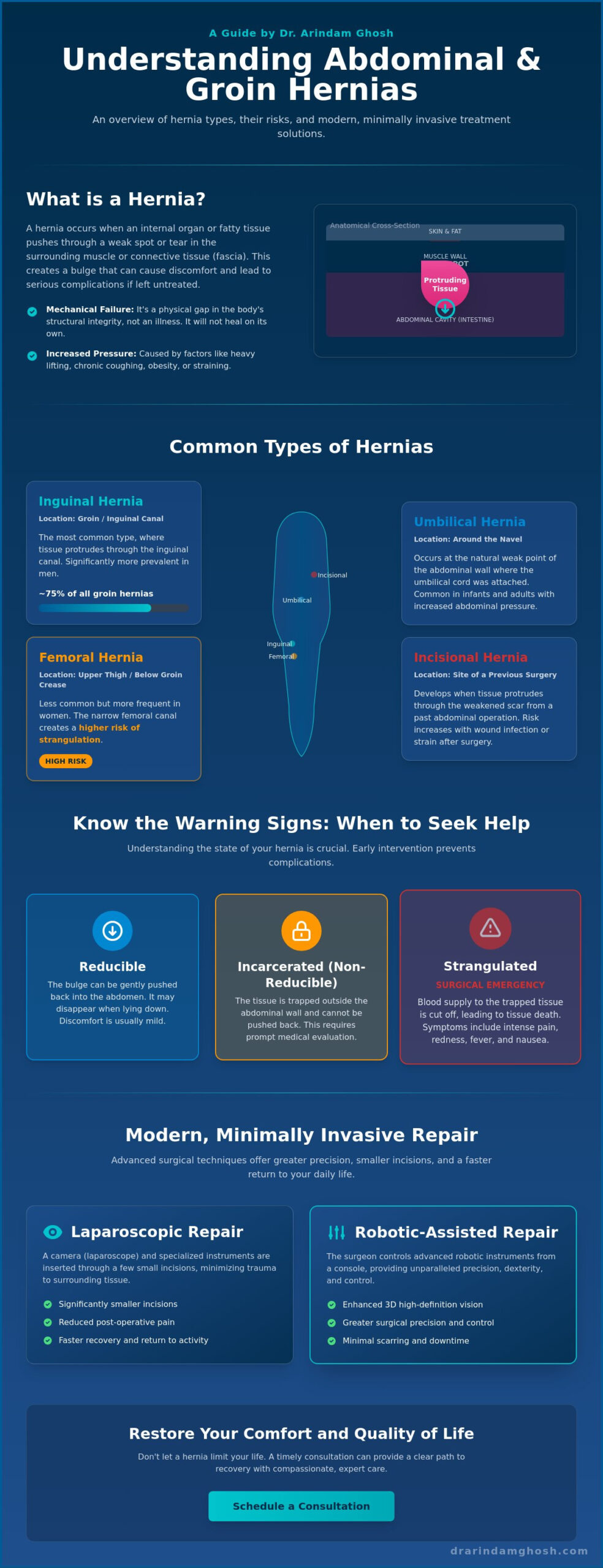
To understand the clinical complexities behind the various types of hernias, we must first view the human body through the lens of biological architecture. A hernia occurs when an internal organ or fatty tissue pushes through a localized weakness or tear in the surrounding muscle wall. Your abdominal wall functions as a sophisticated, pressurized container designed to keep vital organs securely in place. When a breach occurs in this container, the internal pressure naturally forces tissue outward, creating a visible or palpable bulge. This is why What is a Hernia? is often described as a mechanical failure rather than a traditional illness.
From a surgical perspective, it’s vital to recognize that these defects don’t heal on their own. Unlike a strained muscle that repairs itself with rest, a hernia is a physical gap in the body’s structural integrity. The constant pressure from breathing, moving, and digestion prevents the edges of the defect from ever closing naturally. For many patients, this manifests as a persistent tugging sensation or a sharp discomfort during daily activities. Whether you’re lifting a grocery bag or simply sneezing, the impact on your comfort can be immediate and limiting. My goal is to move beyond the restriction of the condition and restore your physical freedom through precise intervention.
The Mechanics of Muscle Weakness
Hernias generally stem from two distinct origins: congenital defects or acquired weaknesses. Some individuals are born with natural openings in the abdominal wall that fail to close properly after birth. Others develop these gaps over time due to consistent intra-abdominal pressure. Chronic coughing, heavy lifting, or obesity act as catalysts that stress the body’s natural defenses. Fascia is the tough connective tissue that usually prevents hernias. When this fascia thins or tears, the internal contents find a path of least resistance, leading to the different types of hernias seen in clinical practice.
When a Hernia Becomes a Medical Priority
In the past, many practitioners suggested “watchful waiting” for small, asymptomatic hernias. However, modern surgical oncology and general surgery standards now emphasize early intervention to avoid future complications. We categorize these defects into two primary states: reducible and non-reducible. A reducible hernia can be pushed back into the abdomen, while a non-reducible, or incarcerated, hernia is trapped. If the blood supply to the trapped tissue is cut off, it becomes a surgical emergency. By utilizing robotic-assisted precision and a multidisciplinary approach, we can address these defects before they escalate, ensuring a faster return to full physical activity and a high quality of life.
Common Types of Hernias: Groin and Abdominal Wall
Understanding the various types of hernias is the first step toward reclaiming your quality of life. Clinical research confirms that 75% of all hernias occur in the groin area, which is why these cases represent a significant portion of our surgical practice. Whether you’re experiencing a subtle bulge or persistent discomfort, identifying the specific anatomical location helps our multidisciplinary team tailor a precise, patient-centered treatment plan that prioritizes your long-term wellness.
Inguinal vs. Femoral: Distinguishing Groin Hernias
Inguinal hernias are the most prevalent variety, occurring when tissue pushes through the inguinal canal. While these are significantly more common in men, women are more likely to develop femoral hernias. These occur in a smaller channel called the femoral canal, located just below the groin crease. Because this pathway is naturally narrow, femoral hernias carry a much higher risk of strangulation, a serious condition where blood supply to the trapped tissue is restricted. You may notice pain that intensifies when you stand for long periods, cough, or strain during physical activity. In our practice, Modern Treatment: Laparoscopic and Robotic Hernia Repair blends robotic precision with a compassionate approach to ensure a safer, more efficient recovery.
Umbilical and Ventral Hernias
The navel is a natural weak point in the abdominal wall where the umbilical cord was once attached. Umbilical hernias happen when tissue or fluid pushes through this area, and they’re common in both infants and adults who experience increased abdominal pressure from obesity or multiple pregnancies. Without a durable, expert repair, these hernias often recur. Ventral hernias serve as a broad clinical category for any protrusion through the frontal abdominal wall. This includes incisional hernias, which develop at the site of a previous surgical scar where the muscle has weakened over time.
Located in the upper abdomen, specifically in the midline between the navel and the breastbone, epigastric hernias represent another common variation. These protrusions typically contain fatty tissue rather than the bowel, yet they still require a surgeon’s touch to ensure the abdominal wall is properly reinforced. Even if these types of hernias seem minor, early intervention is key to preventing future complications and maintaining your physical activity levels.
Every patient’s journey is unique, and we’re here to provide the clinical authority and support you deserve. If you’ve noticed a change in your body or a persistent bulge, a comprehensive evaluation can help determine the best path toward lasting health and comfort.
Complex and Internal Hernias: Beyond the Visible Bulge
While many people associate a hernia with a visible lump, some of the most challenging Common Types of Hernias occur deep within the body’s internal architecture. These defects don’t always present with an obvious protrusion, which often makes them harder to detect without high-level diagnostic imaging like CT scans or MRIs. Understanding these complex types of hernias is a vital step in restoring a patient’s long-term quality of life and comfort.
Hiatal Hernias and Gastrointestinal Health
The diaphragm serves as a critical muscular barrier between the chest and the abdomen. When the hiatus, which is the opening for the esophagus, weakens or widens, a portion of the stomach can migrate upward into the chest cavity. This internal shift disrupts the natural mechanics of digestion. Instead of a physical bulge, patients frequently report debilitating heartburn, chest pain, and difficulty swallowing. These symptoms are often misdiagnosed as simple acid reflux or even cardiac issues. Because these hernias directly impact the gastrointestinal system, we utilize a multidisciplinary approach. By combining surgical expertise with GI oncology principles, we can address the structural defect while simultaneously managing chronic GERD. This holistic perspective ensures that the repair does more than just move the stomach back; it restores the patient’s ability to eat and live without pain.
Incisional Hernias: The Challenge of Recurrent Weakness
Surgical scars are a testament to the body’s ability to heal, yet they never regain the full integrity of original tissue. Research indicates that scar tissue is typically only 80% as strong as healthy fascia. This inherent vulnerability makes any previous surgical site a candidate for an incisional hernia. These defects can be particularly complex because they involve layers of tissue that have already been altered by prior procedures. To manage these, we rely on robotic precision to navigate the delicate abdominal wall. For larger defects, we employ advanced component separation techniques. This involves meticulously reorganizing the existing muscle layers to close the gap without creating excessive tension. In modern surgical practice, using these specialized techniques can reduce the risk of recurrence to less than 10%, offering a pathway to permanent recovery for those who have struggled with repeated failures.
Beyond these common issues, rare types of hernias such as obturator or lumbar defects represent less than 1% of clinical cases. These are deep-seated and difficult to palpate during a standard physical exam. Identifying them requires a clinician who values thoroughness and technological innovation. Whether dealing with a common hiatal defect or a rare lumbar weakness, the goal remains a blend of high-tech compassion and clinical rigor. Every intervention is designed to lead the patient from a state of physical uncertainty toward a future of informed empowerment and renewed wellness.
Symptoms, Diagnosis, and the Risk of Strangulation
Identifying different types of hernias often begins with a simple, personal observation. Most patients first notice a soft lump or protrusion under the skin. This bulge typically becomes more prominent when you stand, cough, or lift heavy objects. A defining characteristic of a reducible hernia is that the lump disappears or flattens when you lie down. It’s a subtle sign, but one that indicates the internal tissue is still moving freely through the muscle gap.
Physical sensations provide further clues. You might feel a dull ache or a persistent sense of “heaviness” in the abdomen or groin. This discomfort isn’t always constant. It often transitions into a sharp, burning sensation after a long day of activity. These physical cues are your body’s way of signaling a structural weakness that requires expert attention. Ignoring these signs can lead to the condition worsening over time, potentially impacting your daily mobility.
Recognizing a Strangulated Hernia
A strangulated hernia occurs when the opening in the muscle wall closes so tightly that it cuts off the blood supply to the trapped tissue. This is a critical surgical emergency. Without blood, the tissue begins to die, leading to necrosis and potentially life-threatening sepsis. A strangulated hernia requires immediate intervention to save the bowel and prevent systemic infection. You must watch for specific red flags that indicate the situation has become urgent:
- Extreme tenderness or sudden, intense pain at the site of the bulge.
- A lump that turns dark red, purple, or dusky in color.
- Nausea, vomiting, and an inability to pass gas or have a bowel movement.
- A fever accompanied by a rapid heart rate.
The Diagnostic Process
During a consultation, a specialist surgeon performs a thorough physical examination. Understanding the various types of hernias is the first step toward effective treatment. You’ll likely be asked to cough or strain while standing. This dynamic approach helps the surgeon see hernias that might hide during rest. To ensure precision, we often utilize ultrasound or CT scans. These tools are vital to differentiate a hernia from other conditions like lipomas (fatty tumors) or swollen lymph nodes.
In some cases, dynamic imaging captures the movement of the bowel through the defect in real-time. This level of detail allows for a personalized treatment plan that prioritizes your long-term quality of life. Our goal is to combine clinical expertise with advanced technology to ensure an accurate diagnosis before any surgical intervention. We look at the whole patient, not just the scan, to determine the safest path forward.
If you’ve noticed a persistent bulge or unexplained abdominal discomfort, it’s time to seek a professional evaluation. Schedule a consultation with Dr. Arindam Ghosh to discuss your symptoms and explore advanced, minimally invasive treatment options.
Modern Treatment: Laparoscopic and Robotic Hernia Repair
The surgical approach to managing different types of hernias has evolved from invasive procedures to sophisticated, patient-centered techniques. In the past, open surgery required large incisions that often led to significant discomfort and a slow recovery. Today, we’ve transitioned toward minimally invasive methods to restore the structural integrity of the abdominal wall with far less disruption to the body. Laparoscopic repair involves the use of a high-definition camera and micro-instruments inserted through small “keyhole” incisions. This method allows the surgical team to view the internal defect with immense clarity, ensuring a precise intervention. The core goal of every procedure is a tension-free repair. We achieve this by using advanced biocompatible mesh that integrates with your natural tissue, providing a stable, long-term solution that minimizes the risk of the hernia returning.
Benefits of Minimally Invasive Techniques
Choosing a minimally invasive approach offers tangible clinical benefits that directly impact a patient’s recovery journey. Because the incisions are small, there’s a notable reduction in reported post-operative pain compared to traditional methods. This often means patients can avoid heavy reliance on pain medications. Clinical data suggests that infection rates are significantly lower in these controlled environments, typically staying below 2% for laparoscopic cases. Most patients find they can return to work or light athletic activities within 10 to 14 days, which is a major improvement over the six-week recovery period often associated with older techniques. These smaller scars aren’t just about aesthetics; they represent a faster healing process for the entire body. For patients in the UAE planning their care, understanding the hernia surgery cost in Dubai is an important part of making a fully informed treatment decision.
The Robotic Advantage in Hernia Surgery
Robotic-assisted surgery brings a new level of robotic precision to the operating room. While the surgeon remains in full control, the robotic system provides 10x magnification and a crystal-clear 3D view of the surgical site. This enhanced visualization is crucial for protecting the delicate nerves and vessels surrounding the various types of hernias. The robotic instruments possess a range of motion greater than the human wrist, allowing for meticulous mesh placement in complex or difficult-to-reach areas. To understand how this technology translates into real-world outcomes for patients, explore the full details of Robotic Hernia Repair: Precision Technology for Restoring Quality of Life. By combining cutting-edge innovation with a compassionate, human touch, we focus on the ultimate goal: restoring your quality of life and returning you to a state of wellness.
Restoring Your Comfort and Quality of Life
Understanding the various types of hernias is the vital starting point for any patient seeking a return to wellness. While symptoms like visible bulges or localized pain can be unsettling, modern medical advancements offer clear, effective solutions. Dr. Arindam Ghosh leverages over 25 years of surgical expertise to provide comprehensive care across premier hospitals in the UAE. By specializing in advanced robotic and laparoscopic techniques, he pairs robotic precision with an essential human touch. These minimally invasive methods are designed to reduce recovery times and help you return to the activities you love.
You don’t have to navigate this health journey alone. A professional evaluation ensures that your treatment plan is as unique as your diagnosis, focusing on a holistic path to recovery. Take the next step toward a pain-free life by seeking guidance from a specialist who values innovation and integrity. Your long-term quality of life is the ultimate goal of every procedure.
Consult Dr. Arindam Ghosh for a personalised evaluation of your hernia
Frequently Asked Questions
Can a hernia go away on its own without surgery?
A hernia won’t resolve on its own because it’s a physical defect in the muscular wall of your abdomen. Clinical data from the British Journal of Surgery indicates that less than 1% of adult hernias heal without medical intervention. While some patients manage symptoms for months, the gap in the tissue remains. We focus on early intervention to prevent the condition from worsening and to protect your long-term quality of life.
Is it safe to exercise if I have a hernia?
You can usually continue light exercise, but you must avoid heavy lifting or high-impact activities that strain the abdominal wall. Surgeons typically recommend a weight limit of 10 to 15 pounds for patients with active hernias. Walking and swimming are excellent ways to maintain wellness without risking complications. We’ll work with you to create a personalized movement plan that keeps you active while ensuring your safety before your scheduled procedure.
What is the difference between an incarcerated and a strangulated hernia?
An incarcerated hernia occurs when tissue becomes trapped in the abdominal opening, while a strangulated hernia is a medical emergency where blood flow is completely cut off. Understanding the different types of hernias is vital for recognizing when you need immediate care. If blood supply isn’t restored within 6 hours, the trapped tissue can die. Our multidisciplinary team uses robotic precision to resolve these urgent cases and restore your health quickly.
How long is the recovery period after laparoscopic hernia surgery?
Most patients return to light daily activities within 3 to 7 days after a laparoscopic procedure. This minimally invasive approach uses small incisions, which significantly reduces post-operative discomfort compared to open surgery. You’ll likely be able to return to desk work within a week, though full athletic activity usually requires 4 weeks of healing. We provide a structured recovery timeline to lead you from uncertainty toward a state of informed empowerment and health.
Will I need a mesh for my hernia repair, and is it safe?
Medical mesh is used in over 90% of hernia repairs today because it creates a much stronger and more durable result. Research from the FDA confirms that using mesh reduces the risk of the hernia returning to less than 5% in most cases. We use high-quality, biocompatible materials that integrate with your natural tissue. This modern advancement allows us to provide a permanent solution that supports your body’s holistic recovery and strength.
Can a hernia return after it has been surgically repaired?
Recurrence is possible, though modern surgical advancements have reduced this risk to between 1% and 10% depending on the technique used. The likelihood of a hernia returning depends on the specific types of hernias being treated and the patient’s adherence to post-operative care. By utilizing reinforced mesh and robotic-assisted precision, we focus on a durable, long-term repair. We guide you through a personalized plan to ensure your lasting stability and wellness.
Is robotic hernia surgery better than traditional laparoscopic surgery?
Robotic surgery offers enhanced precision through 3D visualization and a greater range of motion for the surgeon. The robotic system provides 10x magnification, which allows for a more meticulous repair of the abdominal wall. While both methods are minimally invasive, the robotic approach often results in less internal trauma and a more refined surgical outcome. Learn more about how Robotic Hernia Repair combines precision technology with faster recovery to bridge the gap between clinical facts and the human experience of recovery.
What happens if I choose not to have surgery for my hernia?
Choosing to delay surgery can lead to the hernia increasing in size or becoming a life-threatening emergency. Studies show that approximately 25% of patients with asymptomatic hernias develop symptoms that require surgery within 10 years of diagnosis. Waiting increases the complexity of the eventual procedure and may limit your future quality of life. We provide a calm, balanced perspective to help you decide when the time is right for a definitive, safe solution.