

Consider the case of a 42-year-old professional in Dubai who, upon being diagnosed with an inguinal hernia in early 2024, feared that surgery would sideline their career for several weeks. This anxiety is common, yet modern medical advancements are rapidly changing the narrative for patients across the UAE. Robotic Hernia Repair represents a sophisticated leap forward, combining a surgeon’s clinical expertise with the high-definition precision of robotic-assisted arms. This technology allows for incredibly steady, intricate movements within a very small space, which is vital for ensuring a secure repair while preserving the integrity of surrounding delicate tissues.
It’s natural to feel overwhelmed by the choice between different surgical labels or to worry about the physical toll of recovery. You want a solution that doesn’t just fix the structural problem but allows you to return to your daily life with confidence and minimal discomfort. In this article, you’ll discover how this minimally invasive approach leads to faster healing and significantly improved patient outcomes. We’ll provide a clear overview of the robotic process, explain why it often surpasses traditional methods, and show how a multidisciplinary approach can restore your long-term quality of life.
Key Takeaways
- Understand how robotic technology transforms hernia treatment from a standard procedure into a precise, minimally invasive journey toward long-term healing.
- Explore the science behind Robotic Hernia Repair, featuring wristed instrumentation that mimics the human hand while providing superior steadiness and surgical control.
- Compare modern robotic techniques with traditional approaches to see why smaller incisions lead to a more comfortable and efficient recovery process.
- Learn what to expect during the first 24 hours of recovery and how a patient-centered care plan ensures your transition back to health is seamless.
- Discover the value of a multidisciplinary surgical team in the UAE that prioritizes your unique quality of life through a blend of clinical integrity and compassionate care.
Understanding Robotic-Assisted Hernia Repair
A hernia occurs when an internal organ or fatty tissue pushes through a weakened area in the abdominal muscles or connective tissue. It’s essentially a structural defect that doesn’t heal on its own. While traditional methods have served patients for decades, Robotic-assisted surgery has emerged as a refined evolution of minimally invasive laparoscopy. This technology allows us to address the root of the problem with unprecedented accuracy, focusing on long-term stability and patient comfort.
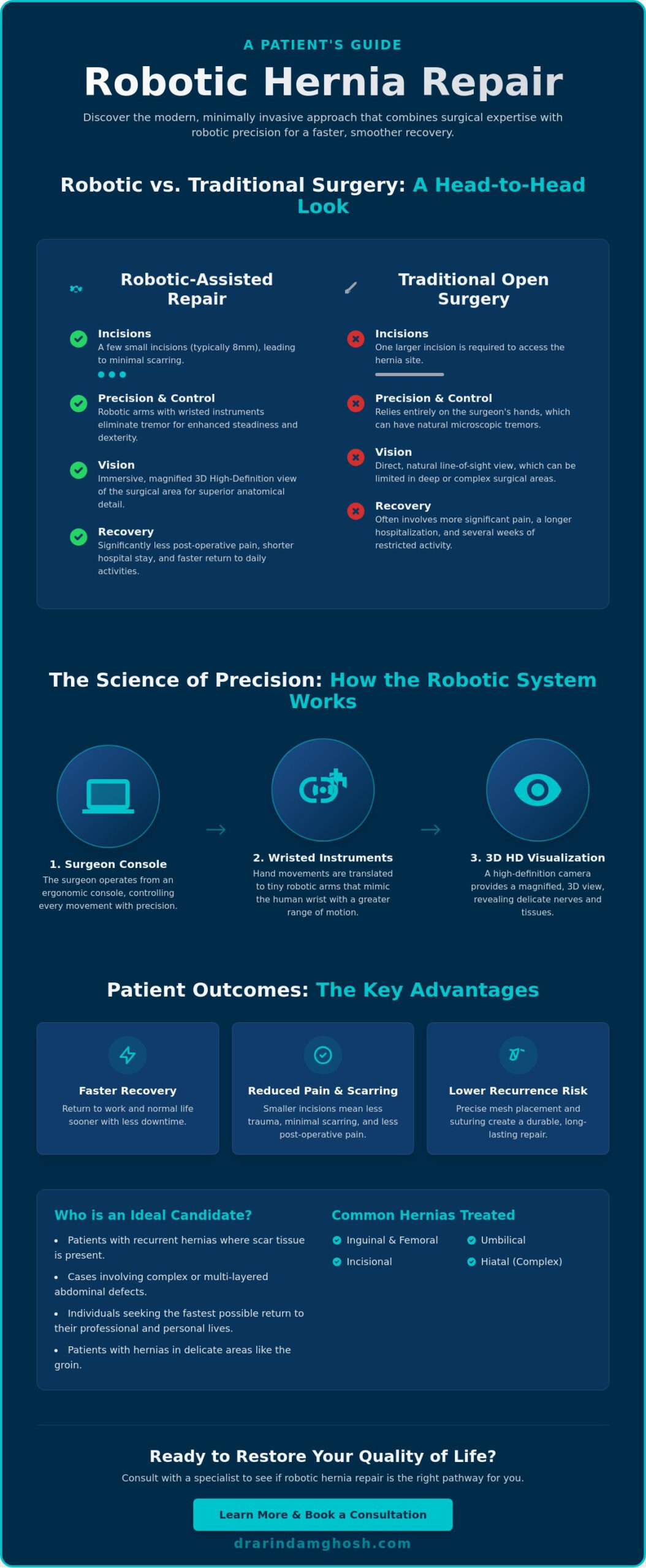
A common misconception is that the robot operates autonomously. This isn’t the case. I remain in complete control of the robotic arms throughout the entire procedure. The system acts as a sophisticated extension of my own hands, filtering out natural tremors and providing a range of motion that exceeds the human wrist. This synergy between the human touch and robotic precision ensures that every stitch and dissection is performed with extreme care. The high-definition 3D camera is another vital component. It provides a magnified view of the surgical field, allowing me to see delicate nerves and blood vessels that are often less visible during open surgery. This level of clarity is essential for a successful Robotic Hernia Repair, as it minimizes the risk of collateral tissue damage.
Common Types of Hernias Treated Robotically
We frequently utilize the robotic platform for inguinal and femoral hernias in the groin. These areas contain a complex network of nerves and vessels; the robotic system’s dexterity makes it easier to place mesh precisely. Umbilical hernias at the belly button and incisional hernias, which occur at the site of a previous surgical scar, also benefit from this approach. For complex hiatal hernias involving the diaphragm, the 3D visualization allows for a more secure repair, significantly reducing the chance of recurrence. In the UAE, where patients often seek the most advanced medical solutions, these robotic techniques have become a standard for those prioritizing a quick return to their professional and personal lives.
Who is a Candidate for Robotic Repair?
Determining candidacy involves a thorough clinical evaluation of your health history and the size of the abdominal defect. Robotic Hernia Repair is often the preferred choice for recurrent hernias, where scar tissue from previous surgeries makes traditional approaches more difficult. According to clinical data from 2022, patients with complex or multi-layered defects often experience better outcomes with robotic assistance due to the superior suturing capabilities. We also consider your overall physical condition and lifestyle goals. During your consultation, we’ll review your diagnostic imaging to ensure this technology is the right pathway for restoring your quality of life and ensuring a durable, lasting repair.
The Science of Precision: How Robotic Systems Work
Robotic-assisted surgery isn’t about a machine replacing a doctor; it’s about extending a surgeon’s natural capabilities to achieve better patient outcomes. During a Robotic Hernia Repair, I operate from a specialized surgeon console, which acts as the nerve center of the procedure. This ergonomic environment allows for total focus, translating my hand movements into micro-movements of the instruments inside the patient’s body. Unlike traditional tools, these “wristed” instruments possess seven degrees of freedom, mimicking and even exceeding the range of motion of the human wrist. This flexibility is vital when working in the tight, complex spaces of the abdominal wall.
The system also incorporates sophisticated tremor filtration technology. Even the steadiest human hand has microscopic tremors, but the robotic interface neutralizes these movements to ensure absolute steadiness. This level of control is particularly beneficial when integrating prosthetic mesh to reinforce the abdominal wall. When Comparing Hernia Surgery Outcomes, data from Michigan Medicine suggests that while the technology requires advanced training, it provides the technical stability needed for complex reconstructions. The mesh is anchored with such accuracy that it provides long-term structural integrity, significantly reducing the risk of the hernia returning. If you’re concerned about a recurring bulge, it may be time to consult with a specialist about advanced repair options.
The Advantage of 3D High-Definition Visualization
Traditional laparoscopic surgery provides a 2D image on a flat monitor, which can limit a surgeon’s depth perception. The robotic system provides a 3D high-definition view that is truly immersive. This 10x magnification allows me to see the distinct layers of tissue and identify vital structures, such as small blood vessels and nerves, with incredible clarity. Accurate depth perception ensures that every suture and mesh placement is executed with the highest degree of confidence, reducing the risk of accidental injury to surrounding organs.
Minimizing Tissue Trauma
The physics of the robotic approach focuses on minimizing the body’s inflammatory response. By using tiny incisions, often no larger than 8 millimeters, we significantly reduce the “tug and pull” on healthy tissues that typically occurs in open or even standard laparoscopic procedures. This gentler handling of the abdominal wall means less post-operative pain and a faster return to daily activities for patients in the UAE. Robotic precision is the ability to operate within millimeters of critical nerves.
- Wristed Instruments: Provide greater dexterity than the human hand in confined spaces.
- Tremor Filtration: Ensures every movement is smooth and deliberate.
- Ergonomic Console: Reduces surgeon fatigue, maintaining high levels of focus throughout the procedure.
- Prosthetic Integration: Allows for the secure and precise placement of reinforcement materials.
Comparing Surgical Approaches: Why Choose Robotic?
The journey of hernia treatment has evolved from extensive open repairs to the refined precision of Robotic Hernia Repair. For decades, the standard was a single large incision that required significant muscle cutting and a long recovery period. While traditional laparoscopy later introduced smaller incisions, its “straight-stick” instruments often limited a surgeon’s range of motion. Robotic technology bridges this gap by providing 3D high-definition visualization and instruments that mimic the human hand’s flexibility, but with a stability that eliminates natural tremors.
Patients often ask about recurrence, which is the return of the hernia after surgery. Clinical data suggests that robotic-assisted techniques can reduce recurrence rates to below 5% for complex ventral hernias, compared to higher rates in traditional methods. This success stems from the ability to place mesh more accurately and close the defect with higher tension-free precision. Pain management also improves significantly. By minimizing tissue trauma, many patients report a 30% to 50% reduction in post-operative opioid use, transitioning quickly to mild over-the-counter relief.
Open vs. Laparoscopic vs. Robotic
Choosing a specific method directly impacts your recovery timeline and physical comfort. Open surgery typically requires an incision of 6 to 10 centimeters, leading to a hospital stay of 2 to 3 days in many Dubai facilities. In contrast, Robotic Hernia Repair utilizes tiny ports of 8 millimeters. This minimal disruption often allows patients to return home within 24 hours. The 10x magnification provided by the robotic system allows for meticulous nerve identification, which is a critical factor in preventing chronic post-surgical pain that affects roughly 10% of traditional surgery patients. Patients who have also experienced gallbladder issues alongside abdominal wall conditions may benefit from understanding how a Laparoscopic Cholecystectomy follows similar minimally invasive principles to achieve a fast, low-disruption recovery.
Is Robotic Surgery Always the Best Option?
While technology offers incredible advantages, it isn’t a universal solution for every patient in the UAE. Certain complex cases, such as very large abdominal wall defects or patients with extensive previous scar tissue, may still necessitate a traditional open approach to ensure safety. Success depends heavily on a personalized multidisciplinary approach where we evaluate your specific anatomy and health history.
A surgeon’s experience remains the most vital component of the procedure. The robot doesn’t perform the surgery; it acts as a highly advanced extension of the surgeon’s skill. We prioritize a holistic view of your wellness, ensuring the chosen technique aligns with the goal of restoring your quality of life and long-term physical function. This collaborative path ensures you receive the most appropriate care for your unique circumstances.
The Path to Recovery: Restoring Your Quality of Life
Recovery begins the moment the Robotic Hernia Repair is complete. Most patients in the UAE experience a swift transition, often being discharged within 6 to 8 hours of their procedure. During the first 24 hours at home, you’ll focus on gentle mobilization. Walking around your living space helps prevent blood clots and aids the digestive system as it wakes up from anesthesia. While you may feel some soreness near the small incision sites, the precision of the robotic instruments minimizes trauma to the surrounding muscle tissue, which significantly reduces the intense pain often associated with traditional open surgery.
We manage post-operative discomfort through a patient-centered, multimodal approach. This strategy combines different types of analgesics, such as paracetamol and anti-inflammatories, to target pain from multiple angles. By using localized nerve blocks during the procedure, we often reduce the need for heavy sedative medications. This allows you to remain alert and active sooner. Most patients find they can return to desk-based work within 5 to 7 days, though we advise waiting 4 to 6 weeks before engaging in heavy lifting or high-impact gym sessions. Follow-up appointments at the 2-week and 6-week marks are essential to ensure the mesh has integrated perfectly with your natural tissue.
If you’re ready to discuss how this advanced surgical approach can help you return to your daily routine without pain, schedule a consultation with Dr. Arindam Ghosh today.
Preparation for a Successful Procedure
Success starts weeks before you enter the operating theater. We recommend a high-protein diet and Vitamin C supplementation to prime your body’s cellular repair mechanisms. If you smoke, ceasing at least four weeks prior to surgery improves oxygen delivery to the healing tissue. During your consultation, don’t hesitate to ask about the specific mesh material being used or the expected duration of your anesthesia. You should also arrange for a friend or family member to assist with household chores and driving for the first 48 hours to ensure a stress-free environment.
Long-Term Outcomes and Wellness
The ultimate goal of Robotic Hernia Repair is a permanent return to a meaningful, active existence. Long-term wellness depends on maintaining a stable weight and building core strength to support the abdominal wall. Incorporating low-impact exercises like swimming or Pilates after your 6-week clearance can prevent future recurrences. By 2026, the global clinical standard for hernia recovery predicts that 95 percent of robotic surgery patients will resume full physical activities within 21 days of their procedure. This evolution in care ensures that your surgery isn’t just a clinical fix, but a bridge back to the life you love.
Personalized Care: Integrating Innovation with Integrity
True healing begins when we treat the individual, not just the clinical diagnosis. Dr. Arindam Ghosh brings over 25 years of surgical expertise to every case, ensuring that innovation always serves the patient’s well-being. While Robotic Hernia Repair provides the mechanical precision required for modern surgery, the philosophy of care remains rooted in integrity and empathy. This approach shifts the focus from a standard procedure to a comprehensive journey toward health.
Complex gastrointestinal cases often require more than a single perspective. A multidisciplinary team is essential for navigating the nuances of abdominal wall reconstruction and surgical oncology. By collaborating with specialists in nutrition, pain management, and physiotherapy, we ensure that the recovery phase is as meticulous as the surgery itself. This collective expertise is particularly important for patients in the UAE who lead active lifestyles and want to return to their routines quickly. Our commitment moves beyond the clinical task toward a vision of holistic wellness that respects the patient’s entire life story. For patients whose hernia risk is compounded by excess weight, exploring a minimally invasive option such as Laparoscopic Sleeve Gastrectomy may also be an important part of a comprehensive treatment plan. Similarly, patients with a history of abdominal conditions should be aware that robotic surgical expertise extends to gastrointestinal cancer surgery, where the same precision and multidisciplinary approach guides treatment and recovery.
- Holistic assessment of pre-existing conditions and lifestyle factors.
- Customized recovery protocols based on individual activity levels and goals.
- Continuous monitoring to ensure the long-term stability of the repair.
The Human Touch in High-Tech Surgery
Technology is a tool, but the surgeon is the guide. Building trust through transparent communication is the cornerstone of patient-centric care. In the robotic era, the reassuring role of the surgeon is more vital than ever. Patients need to know that their concerns are heard and their unique physiological needs are respected. Dr. Ghosh combines clinical authority with a calm, balanced perspective, ensuring that every patient feels like a partner in their recovery. This high-tech compassion bridges the gap between advanced medical science and the human experience of illness.
Taking the Next Step Toward Recovery
Persistent abdominal symptoms or a visible bulge shouldn’t be ignored. Seeking expert care early can prevent the progression of a hernia and reduce the risk of emergency complications. To schedule a comprehensive evaluation, patients can contact the clinic directly to arrange a consultation. During your initial visit, Dr. Ghosh will perform a thorough physical exam and review your symptoms to determine if Robotic Hernia Repair is the right path for you. To make the most of your consultation, please bring the following items:
- Recent imaging results, such as ultrasounds or CT scans, if already performed.
- A detailed list of current medications, supplements, and dosages.
- Records or summaries of any previous abdominal or pelvic surgeries.
Restoring your quality of life starts with a single, informed decision. By choosing a path that integrates cutting-edge technology with decades of hands-on experience, you’re choosing a future defined by wellness and mobility. We are here to support you at every stage of the process, from the first diagnostic step to your final follow-up appointment.
Embrace a Future of Enhanced Mobility and Comfort
Choosing the right surgical path requires a balance of innovative technology and seasoned clinical wisdom. Robotic Hernia Repair represents the pinnacle of this synergy, offering 3D high-definition visualization that allows for unmatched surgical accuracy. This precision helps reduce post-operative pain and accelerates your return to the active lifestyle you enjoy in the UAE. Dr. Arindam Ghosh brings over 25 years of specialized surgical experience to every case, blending high-tech robotic tools with a deeply compassionate, patient-centric philosophy. His expertise in advanced gastrointestinal and bariatric procedures ensures that your treatment is both evidence-based and tailored to your unique physiology.
By focusing on a multidisciplinary approach, the goal remains a complete restoration of your quality of life rather than just a clinical fix. It’s about more than just the procedure; it’s about the integrity of the care you receive throughout your healing journey. You deserve a recovery that’s as seamless as the technology used to facilitate it. Take the first step toward a pain-free life with a team that values your long-term wellness and professional safety standards. For a transparent breakdown of what to expect financially, reviewing the hernia surgery cost in Dubai can help you plan your care with complete confidence.
Consult with Dr. Arindam Ghosh for an expert evaluation of your hernia repair options.
Frequently Asked Questions
Is robotic hernia repair safer than traditional surgery?
Robotic hernia repair offers a higher safety profile than open surgery by reducing the risk of surgical site infections by up to 50 percent according to clinical data. The precision of the robotic arms minimizes trauma to surrounding healthy tissue and nerves. This technology allows me to visualize the surgical field in 3D high-definition, which enhances accuracy and significantly lowers the likelihood of post-operative bleeding or hernia recurrence.
How long does the robotic hernia repair procedure take?
A standard robotic hernia repair typically takes between 60 and 90 minutes to complete, though complex cases may require additional time. This duration includes the setup of the robotic system and the precise placement of the reinforcement mesh. While the procedure might take slightly longer than traditional laparoscopic methods, the increased precision and reduced tissue disruption often lead to a more efficient and comfortable recovery process for the patient.
Can a robotic system perform the surgery without a human doctor?
No, the robotic system can’t perform any action without the direct, real-time control of a skilled surgeon. It’s a sophisticated instrument that translates my hand movements into micro-movements within your body. Every incision and stitch is the result of human decision-making. The technology simply enhances my ability to provide robotic hernia repair with greater stability and a range of motion that exceeds the natural human hand. This synergy between human expertise and mechanical precision is a hallmark of modern technology; just as a surgeon oversees every move, specialists at Drone Doctor LLC provide the essential technical care and repair services required to keep advanced robotic systems functioning at their peak.
What is the typical recovery time before I can return to work?
Most patients return to light office work within 7 to 10 days after a robotic hernia repair. If your job involves heavy lifting or physical labor, I usually recommend waiting 4 to 6 weeks to ensure the repair is fully healed. Because the incisions are small, typically less than 1 centimeter, the initial discomfort is managed effectively with simple pain relief, allowing for a faster return to your daily activities.
Will I have a permanent mesh inside me after robotic surgery?
Yes, a medical-grade mesh is typically used to reinforce the weakened abdominal wall and prevent the hernia from returning. Clinical studies indicate that using mesh reduces the recurrence rate to less than 5 percent, compared to much higher rates without it. These modern materials are designed to integrate with your body’s natural tissue over time, providing a durable and long-lasting solution that supports your long-term quality of life.
Is robotic hernia surgery more expensive than other methods?
Robotic surgery generally carries a higher initial cost in the UAE compared to open or laparoscopic methods due to the advanced technology and specialized equipment used. However, the total financial impact is often balanced by shorter hospital stays and a faster return to work. Many private insurance providers in Dubai and Abu Dhabi now cover robotic-assisted procedures, though you should verify specific coverage limits with your individual policy provider in UAE Dirhams (AED). For a detailed breakdown of what these procedures typically cost and what factors influence pricing, our comprehensive guide to hernia surgery cost in Dubai for UAE patients provides the transparency you need to plan ahead.
How many incisions are made during a robotic hernia repair?
I typically make three small incisions, each measuring between 8 and 12 millimeters, to perform the repair. These tiny ports allow the robotic instruments and the high-definition camera to access the hernia site without the need for a large, invasive opening. This minimally invasive approach is a hallmark of robotic hernia repair, leading to less scarring and a more aesthetic outcome compared to the 10-centimeter incisions often required in traditional surgery.
What happens if the robotic system fails during surgery?
If a technical issue occurs with the robotic system, I immediately transition the procedure to a traditional laparoscopic or open surgery to ensure your safety. This is a standard safety protocol that all robotic surgeons are trained for, and the equipment is designed with multiple redundant systems to prevent failure. My multidisciplinary team and I remain fully prepared to complete the surgery manually, prioritizing your well-being and the successful restoration of your health. Patients who have undergone or are considering other minimally invasive abdominal procedures, such as a Laparoscopic Cholecystectomy for gallbladder removal, can take confidence in knowing that the same rigorous safety protocols and surgical preparedness apply across all procedures performed by our team.
4 comments
Pingback: Robotic Surgeon Dubai: Advancing Precision in Modern Gastrointestinal Care
Pingback: Hernia Surgery Cost in Dubai: A Comprehensive Guide for UAE Patients
Pingback: The Ultimate Guide to Hernia Surgery Preparation: A Surgeon’s Perspective
Pingback: Robotic Surgery in the UAE: The Future of Precision Gastrointestinal Care