

What if the complete absence of pain is actually the most complex clinical signal your body can send? In clinical practice, roughly 80% of gallstone cases are asymptomatic at the time of discovery, which often leaves patients in the UAE feeling like they’re carrying a ticking time bomb. You’re likely caught between the relief of being symptom-free and the fear that a silent condition might suddenly turn into an emergency surgical procedure while you’re at work or traveling. Understanding silent gallstones when to worry is essential because proactive management is often the difference between a planned, minimally invasive recovery and an urgent intervention.
I recognize the confusion that comes with conflicting medical advice, especially when you feel perfectly healthy today. This article provides the clinical clarity you need by outlining the specific indicators that determine when a laparoscopic cholecystectomy is necessary to protect your long-term wellness. We’ll walk through a professional checklist of when to seek a surgeon and explore how modern medical advancements can restore your peace of mind. You’ll gain a clear understanding of your risk profile, allowing you to move from a state of uncertainty to a state of informed empowerment regarding your health and quality of life.
Key Takeaways
- Learn how to differentiate between “watchful waiting” and clinical necessity to understand silent gallstones when to worry based on your unique risk profile.
- Discover why specific indicators, such as stones exceeding 3cm or a porcelain gallbladder, require proactive intervention to prevent serious long-term complications.
- Identify the subtle red flags, including chronic bloating and fatty food intolerance, that signal a transition from a silent condition to a symptomatic one.
- Understand the 1% to 4% annual risk rate and how a multidisciplinary approach helps you manage asymptomatic cases with clinical precision.
- Explore how a planned laparoscopic cholecystectomy prioritizes your quality of life by preventing the need for emergency surgical procedures.
Table of Contents
- What Are Silent Gallstones and Why Are They Found Incidentally?
- The 'Wait and Watch' Approach: When Is It Safe?
- Risk Stratification: Specific Indicators That It Is Time to Worry
- Monitoring Your Health: The Subtle Red Flags of Complications
- Choosing Proactive Care: The Role of Laparoscopic Cholecystectomy
What Are Silent Gallstones and Why Are They Found Incidentally?
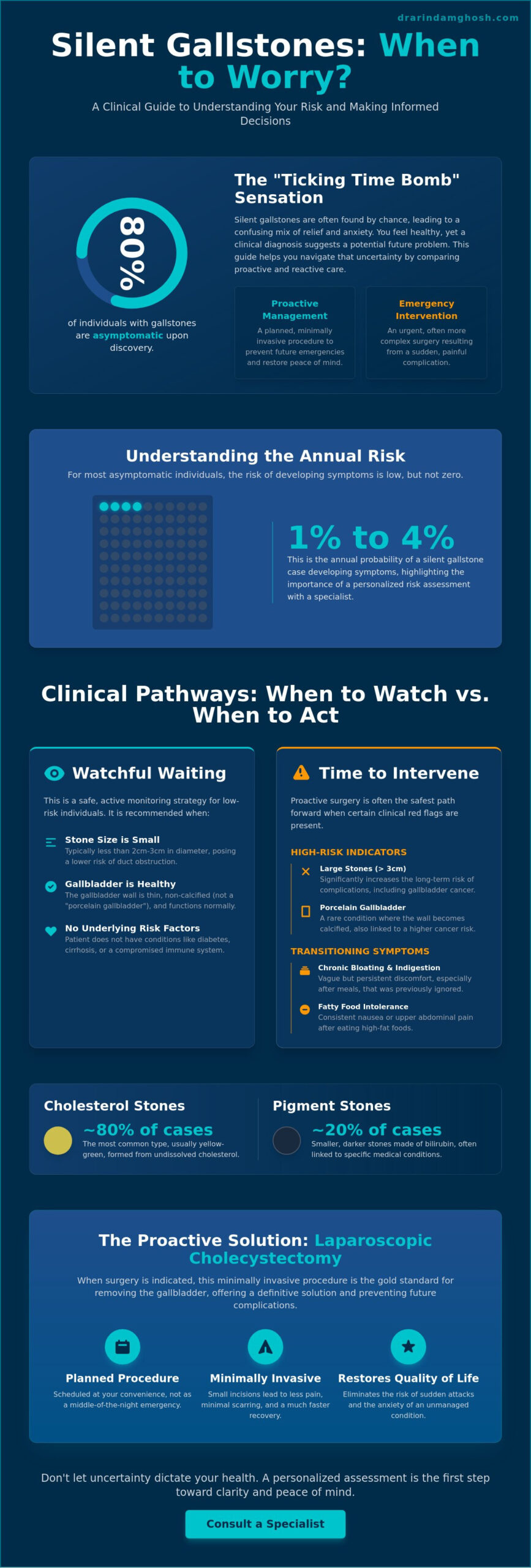
Asymptomatic cholelithiasis, commonly known as silent gallstones, is a clinical state where hardened deposits of digestive fluid form within the gallbladder without triggering the classic symptoms of biliary colic or acute inflammation. With modern diagnostic capabilities, these stones are frequently identified during routine health screenings or imaging for unrelated abdominal concerns. Research indicates that approximately 80% of individuals with gallstones remain asymptomatic for years, often living their entire lives without experiencing a single painful episode. This high prevalence means that many individuals may only learn of their condition through a routine ultrasound or CT scan intended to check for other issues.
The chemical makeup of these stones plays a significant role in their behavior and management. Understanding What Are Gallstones involves distinguishing between cholesterol stones, which account for about 80% of cases in developed regions, and pigment stones, which are darker and often associated with blood disorders or infections. While the composition itself doesn’t always dictate immediate pain, it helps your multidisciplinary team assess your long term risk profile and determine the best approach for your specific health journey. When patients receive this diagnosis, the immediate question is often about silent gallstones when to worry, as the gap between feeling healthy and having a clinical diagnosis can feel unsettling.
The Anatomy of a Silent Stone
A gallstone remains “silent” as long as it stays within the body of the gallbladder and doesn’t migrate to block the cystic duct. When a stone is small or sits away from the gallbladder’s exit, bile can still flow freely, which prevents the pressure buildup that causes intense pain. It’s important to distinguish these from stones in the common bile duct, which almost always require urgent intervention. While some stones remain quiet for decades, others may shift position during digestion, causing the first signs of discomfort that signal a change in your clinical status.
Why Symptoms Might Be ‘Absent’ but Not ‘Gone’
Silent gallstones are a condition of presence without current obstruction. However, many patients realize in hindsight that their “silence” actually included mild, ignored indigestion or vague discomfort after heavy meals. The psychological impact of an incidental discovery is real; it’s common to feel as though you’re carrying a ticking time bomb in your abdomen. My role is to help you move past that fear by providing a clear, evidence based plan that prioritizes your quality of life. By monitoring these “sleepers” with professional precision, we ensure that your health remains protected without the stress of constant uncertainty.
The ‘Wait and Watch’ Approach: When Is It Safe?
Receiving a diagnosis of asymptomatic cholelithiasis often brings a sense of relief, as it implies no immediate pain or lifestyle disruption. In clinical practice, surgeons frequently recommend expectant management, or the ‘wait and watch’ approach, for low-risk patients. This strategy is grounded in the statistical reality that only 1% to 4% of people with silent stones develop symptoms each year. For many, these stones remain dormant for decades without ever requiring intervention. However, determining silent gallstones when to worry requires a personalized risk assessment rather than a one-size-fits-all rule.
Safe waiting is typically reserved for patients with stones smaller than 2cm, a thin and healthy gallbladder wall, and no underlying medical conditions like diabetes or immunosuppression. While diet alone cannot dissolve existing stones, a low-fat, high-fiber intake helps reduce the gallbladder’s workload. This prevents the organ from contracting too forcefully, which often triggers the symptoms of a gallbladder attack. Maintaining a healthy weight and avoiding rapid weight loss are also critical factors in keeping these stones silent and avoiding the need for urgent care.
What Expectant Management Actually Involves
Choosing to monitor your condition isn’t a passive decision; it’s an active clinical strategy designed to safeguard your quality of life. It involves regular follow-up imaging, such as an annual abdominal ultrasound, to check for changes in stone size or gallbladder wall thickness. Periodic liver function tests are also essential to ensure there’s no silent obstruction in the bile ducts. Establishing a direct line of communication with a gastrointestinal surgeon ensures that if your status shifts, you have an ally who understands your history. If you’re feeling uncertain about your current monitoring plan, a professional consultation can provide the clinical clarity you need.
When Waiting Becomes a Risk
The logic behind ‘waiting and watching’ changes when we look at long-term outcomes. For a 35-year-old patient, a 2% annual risk translates to a significant cumulative chance of an emergency over 20 years. Age plays a vital role here; younger patients have more ‘years at risk’ for a complication to occur. There’s also a psychological dimension to consider. Living with the knowledge of an asymptomatic diagnosis can cause persistent anxiety, which often impacts a patient’s overall wellness. In these cases, the ‘hidden cost’ of waiting may eventually outweigh the benefits of avoiding a routine, elective procedure.
Risk Stratification: Specific Indicators That It Is Time to Worry
While the “wait and watch” strategy is appropriate for many, clinical precision requires us to look closer at individual risk factors that shift the balance toward intervention. In my practice, we use risk stratification to identify when asymptomatic stones transition from a manageable presence to a potential health threat. Understanding silent gallstones when to worry involves looking beyond the absence of pain and examining the physical characteristics of the stones and the patient’s overall medical profile. For example, stones larger than 3cm are a significant clinical marker because they are associated with a higher incidence of gallbladder carcinoma. Finding a stone of this size serves as a critical marker for a surgical consultation to prevent long term complications.
Another definitive indicator for proactive care is a porcelain gallbladder. This occurs when the gallbladder wall becomes calcified and brittle, a condition often discovered incidentally during imaging. Because of the high correlation between wall calcification and malignancy, immediate attention is usually required. Similarly, patients with hemolytic anemia or sickle cell disease face a unique challenge. Their bodies produce pigment stones at a much higher rate, which increases the likelihood of sudden, severe obstructions. Professional approaches to managing asymptomatic gallstones often shift when these specific anatomical or systemic changes are detected, as the risks of waiting outweigh the benefits of observation.
Medical Conditions That Change the Rules
Certain comorbidities significantly alter the safety profile of silent gallstones. For patients with diabetes, the risk of developing a severe, “painless” gallbladder infection is a major concern. Diabetes can dull the body’s pain response, meaning a serious infection could escalate rapidly before the patient feels enough discomfort to seek help. We also take extra precautions with immunocompromised individuals or those managing cirrhosis and portal hypertension. In these cases, a multidisciplinary team approach ensures that we address the stones before they lead to an emergency that the patient’s body might struggle to handle.
The Size and Number Factor
The physical nature of the stones provides vital clues for our surgical strategy. While one large stone carries a cancer risk, multiple small stones present a different danger: migration. Small stones can easily escape the gallbladder and enter the common bile duct, potentially causing jaundice or life-threatening pancreatitis. We also distinguish between solid stones and gallbladder sludge. While sludge can sometimes be managed with lifestyle changes, it often acts as a precursor to more complex obstructions. For patients in the UAE planning bariatric surgery, such as a laparoscopic sleeve gastrectomy, addressing these stones beforehand is essential to prevent post-operative complications during rapid weight loss.
Monitoring Your Health: The Subtle Red Flags of Complications
Monitoring your health after an incidental finding requires a keen awareness of how your body responds to daily life. While we often focus on the absence of acute pain, there is a spectrum of subtle indicators that suggest a change in clinical status. Many patients dismiss chronic bloating or a vague sense of heaviness after a meal as simple indigestion. However, these atypical symptoms, alongside a growing intolerance to fatty foods, often serve as the earliest markers of silent gallstones when to worry. Identifying these low-grade issues early allows us to plan a controlled intervention rather than reacting to a medical emergency, ultimately preserving your quality of life.
Biliary colic represents the first definitive signal that a stone is no longer just sitting quietly. This pain typically manifests in the upper right quadrant of the abdomen and may radiate toward the right shoulder or between the shoulder blades. In approximately 15% of symptomatic cases, gallstones lead to secondary complications that manifest through systemic signs. If you notice a yellowish tint in the whites of your eyes, known as jaundice, or experience unexplained fever and chills, these indicators suggest that the condition has progressed beyond the gallbladder itself. Such signs require an immediate evaluation by a multidisciplinary team to prevent further complications.
The Progression of Pain
It is essential to distinguish between a heavy meal and a true gallbladder attack. Gallbladder issues frequently strike at night or several hours after a large dinner, as the organ contracts to process fats. While minor indigestion passes quickly, pain that persists and intensifies for more than 5 hours is a significant clinical marker. This specific duration often suggests that a stone is firmly lodged in the duct, creating a risk of infection or tissue damage that requires urgent surgical attention to ensure a safe recovery.
Signs of Secondary Complications
When stones move beyond the gallbladder, they can trigger more complex conditions that impact your long-term wellness. Pancreatitis presents as intense abdominal pain that travels straight through to the back, while cholecystitis is marked by persistent tenderness and a rigid feeling in the upper right abdomen. A common bile duct obstruction often reveals itself through changes in bodily waste; dark, tea-colored urine and pale, clay-colored stools are critical indicators that bile flow is blocked. If you are experiencing any of these warning signs, it is time to schedule an urgent clinical assessment to discuss your surgical options and restore your health with professional precision.
Choosing Proactive Care: The Role of Laparoscopic Cholecystectomy
Choosing to move forward with a surgical solution is a significant step in your health journey. In the modern surgical landscape of the UAE, the shift toward proactive care is driven by a desire to prioritize long-term quality of life and avoid the risks associated with emergency interventions. While we have discussed the markers of silent gallstones when to worry, such as stone size and specific comorbidities, the ultimate goal of a planned procedure is to provide a controlled, safe environment for your recovery. By opting for an elective laparoscopic cholecystectomy, we can ensure the highest standards of clinical precision while the patient is in optimal health, rather than waiting for an acute episode of inflammation or infection.
Laparoscopic cholecystectomy is the gold standard for gallbladder removal, utilizing minimally invasive techniques that involve three or four tiny incisions, typically between 5mm and 10mm in size. This approach offers remarkable safety and precision, allowing for a much faster recovery than traditional methods. In my practice, I combine the latest technological advancements with a deeply personal approach. I view every procedure as a partnership where robotic precision meets the human touch. This philosophy ensures that while we use the most sophisticated tools available, we never lose sight of the individual behind the diagnosis, focusing on a multidisciplinary approach that supports your holistic wellness.
Benefits of a Planned vs. Emergency Procedure
Elective surgery offers several distinct advantages over emergency care. Data shows that complication rates are significantly lower in planned procedures, as there is no active infection or severe inflammation to navigate. Patients benefit from better cosmetic outcomes because the incisions are meticulously placed and small. Perhaps most importantly, a planned procedure reduces the immense stress that an emergency surgery places on both the patient and their family. You can schedule your care at a time that suits your professional and personal life in Dubai or Abu Dhabi, ensuring a calm and structured pathway to health.
Restoring Your Quality of Life
Many patients worry about how their body will function without a gallbladder. It’s reassuring to know that your liver continues to produce bile for digestion; the gallbladder simply served as a storage reservoir. Most patients return to their normal diet and daily activities within 7 days of a planned procedure, experiencing a newfound freedom from the “ticking time bomb” anxiety of an asymptomatic diagnosis. For a deeper look at the process, you can read our Laparoscopic Cholecystectomy: A Patient-Centric Guide. If you’re ready to move from uncertainty to a state of informed empowerment, I invite you to consult with a specialist to discuss your silent gallstones and determine the best path forward for your long-term health.
Empowering Your Path to Long-Term Digestive Health
Navigating a diagnosis of asymptomatic gallstones requires a careful balance of clinical vigilance and informed decision-making. We’ve explored how specific risk factors, like stone size and underlying medical profiles, provide the necessary context for silent gallstones when to worry. By recognizing subtle red flags and understanding the safety of modern surgical techniques, you can move from a state of uncertainty to a state of proactive wellness. A planned, minimally invasive procedure often serves as the most effective pathway to restoring your quality of life and preventing future emergencies.
With over 25 years of surgical experience and a deep focus on robotic assisted precision, I’m dedicated to providing high-level care across premier hospitals in the UAE. I invite you to Schedule a Consultation with Dr. Arindam Ghosh to Assess Your Gallbladder Health and receive a personalized management plan tailored to your unique needs. Taking this step ensures that your health remains in expert hands, allowing you to live with confidence and lasting peace of mind.
Frequently Asked Questions
Can silent gallstones disappear without surgery?
Gallstones don’t typically dissolve or disappear on their own once they have hardened into solid deposits. While some alternative “gallbladder flushes” are marketed online, they aren’t supported by clinical evidence and can actually be dangerous by causing a stone to lodge in the bile duct. A laparoscopic cholecystectomy remains the only definitive way to remove the stones and the organ where they form, ensuring they don’t return.
Is it dangerous to leave silent gallstones untreated for years?
It’s generally safe to monitor silent stones if you’re in a low-risk category, but the cumulative risk of an emergency grows over time. Each year, there’s a 1% to 4% chance that asymptomatic stones will cause a painful complication. For a younger patient in the UAE, this means a significant statistical probability of requiring an urgent surgical procedure at some point over the next 20 years.
What is the most common trigger that turns a silent gallstone into a painful one?
Consuming a high-fat or particularly heavy meal is the most frequent trigger for gallbladder pain. When you eat fats, your gallbladder contracts to release bile into the digestive tract. If that contraction pushes a stone into the cystic duct, it creates a blockage. This obstruction leads to the intense, localized pain known as biliary colic, which often strikes late at night.
Do I need a special diet if I have asymptomatic gallstones?
Adopting a low-fat, high-fiber diet is a practical way to manage the workload of your gallbladder. While a change in diet won’t dissolve existing stones, it prevents the organ from contracting too forcefully, which reduces the risk of a stone becoming stuck. It’s also vital to avoid rapid weight loss, as losing more than 1.5kg per week can actually trigger the formation of more stones.
What size of gallstone is considered dangerous?
Stones larger than 3cm are considered a critical threshold for surgical consultation because they are linked to a higher risk of gallbladder cancer. Understanding silent gallstones when to worry also involves watching for very small stones, often less than 5mm. These tiny stones are dangerous because they can easily migrate into the common bile duct, potentially causing life-threatening pancreatitis or jaundice.
How often should I get an ultrasound to monitor my silent gallstones?
Most clinical guidelines recommend an annual abdominal ultrasound for patients who choose expectant management. This allows your multidisciplinary team to check for changes in stone size or any thickening of the gallbladder wall, which can indicate chronic inflammation. If you begin to experience even vague upper abdominal discomfort or bloating, you should schedule a follow-up imaging session immediately rather than waiting for your yearly check-up.
Can silent gallstones cause cancer if left alone?
The risk of gallbladder cancer is low but increases if stones are left to cause chronic irritation over several decades. This risk is highest for patients with stones exceeding 3cm or those with a porcelain gallbladder, where the wall has become calcified. In these specific cases, proactive surgery is often the best pathway to protect your long-term wellness and ensure a return to a healthy existence.
Is gallbladder removal a major surgery?
Laparoscopic cholecystectomy is a routine, minimally invasive procedure that we perform with high-tech precision. Because the incisions are tiny, usually between 5mm and 10mm, the impact on the body is significantly less than traditional open surgery. Most patients in our UAE clinics return home within 24 hours and are back to their normal quality of life and professional activities within 7 days.