

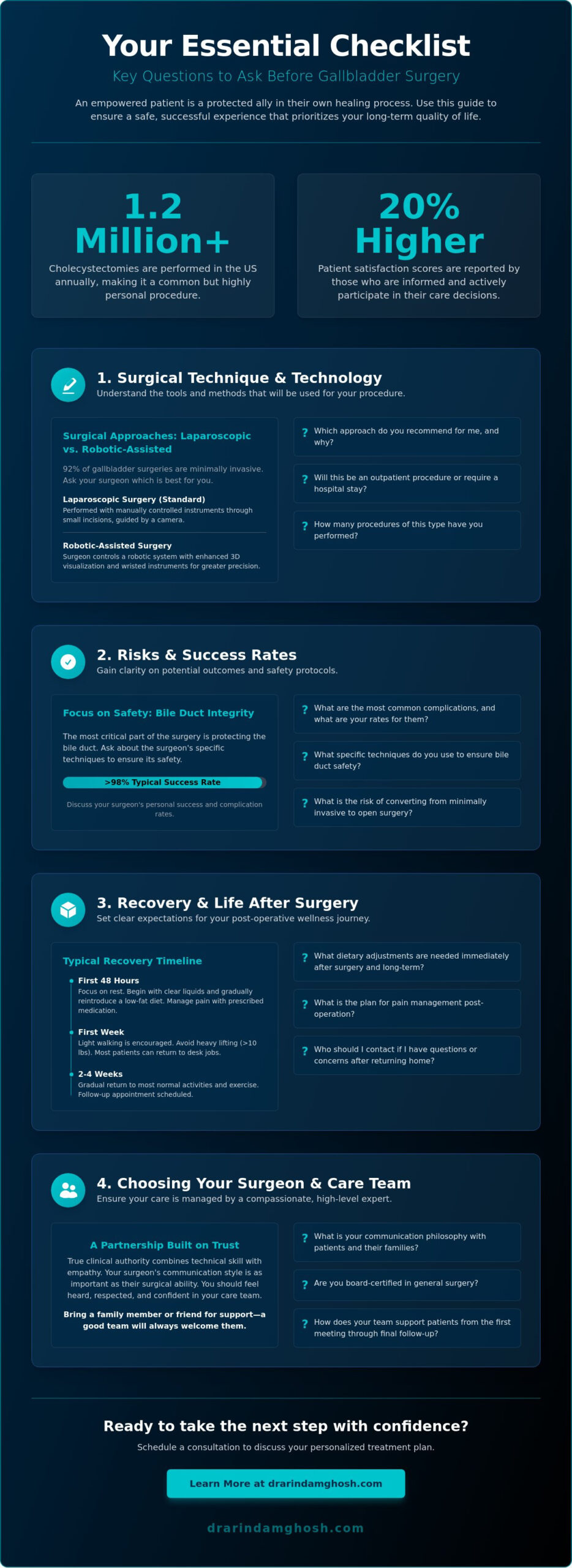
The most critical instrument in a successful surgery isn’t the robot or the laparoscope; it’s the list of questions you bring to your initial consultation. While over 1.2 million cholecystectomies are performed in the US each year, your health journey is deeply personal. It’s natural to feel a sense of uncertainty regarding recovery times or the technical choice between laparoscopic and robotic approaches. Identifying the right questions to ask a surgeon before gallbladder removal is the first step in moving from a state of apprehension to one of informed empowerment.
We believe that surgical excellence is a partnership built on transparency and empathy. You deserve a roadmap that leads back to a healthy, active life without the weight of clinical confusion. This guide provides a comprehensive checklist to help you evaluate surgical expertise and understand the April 1, 2026, CMS price transparency rules. We’ll explore how to discuss specific outcomes and recovery milestones, ensuring you feel like a protected ally in your own healing process. By the end of this article, you’ll have the tools to secure a safe, successful experience that prioritizes your long-term quality of life.
Key Takeaways
- Evaluate the clinical benefits of robotic-assisted versus laparoscopic approaches to determine which precision-driven method best supports your unique anatomy.
- Identify the specific questions to ask a surgeon before gallbladder removal regarding their personal success rates and specialized techniques for ensuring bile duct safety.
- Gain a methodical understanding of post-operative wellness, including specific dietary adjustments required in the first 48 hours for a seamless transition back to normal life.
- Learn how to verify a surgeon’s credentials and communication style to ensure your care is managed by a compassionate, high-level expert who prioritizes your quality of life.
Table of Contents
- Empowering Your Surgical Journey: Why Asking the Right Questions Matters
- Surgical Expertise and Technology: Questions About the Procedure
- Understanding Risks and Success Rates: Ensuring Clinical Safety
- The Road to Recovery: Questions About Life After Gallbladder Removal
- Making the Final Decision: Why Choice of Surgeon is Key
Empowering Your Surgical Journey: Why Asking the Right Questions Matters
A surgical consultation is much more than a routine medical review; it’s a vital opportunity to build a foundation of trust between you and your care team. When you walk into the clinic, you’re not just a case file or a set of symptoms. You’re an individual seeking a return to wellness. By preparing a thoughtful list of questions to ask a surgeon before gallbladder removal, you actively participate in your own healing process. This proactive approach is backed by clinical evidence. Studies indicate that informed patients report 20% higher satisfaction scores and experience significantly lower levels of post-operative anxiety compared to those who remain passive. We view this initial meeting as the cornerstone of a personalized treatment plan, moving the focus from the stress of a diagnosis to the clarity of a successful outcome.
The transition from “what is happening” to “how we will achieve the best outcome together” requires open communication and shared goals. In the United States, over 1.2 million cholecystectomies are performed annually, making it one of the most common surgical interventions. However, the frequency of the procedure doesn’t diminish the importance of your specific experience. Every patient deserves a roadmap that balances technical expertise with a compassionate understanding of their lifestyle and recovery needs. This partnership ensures that the clinical path we choose is the one that best restores your quality of life.
Moving from Uncertainty to Informed Empowerment
Specific questions help clarify why a procedure is necessary at this specific time and what alternatives might exist. You should feel comfortable exploring your surgeon’s philosophy on patient care and their preferred techniques, whether they favor robotic precision or traditional laparoscopic methods. Understanding Cholecystectomy involves more than knowing the steps of the surgery; it’s about understanding how those steps apply to your unique anatomy. We define the informed consent process as a collaborative dialogue where clinical expertise and patient preferences meet to ensure the highest safety standards. This clarity helps remove the uncertainty that often accompanies a surgical recommendation.
The Role of Clinical Authority and Empathy
A surgeon’s communication style is just as vital as their technical skill with a laparoscope or robotic system. True clinical authority is rooted in the ability to explain complex gastrointestinal issues in a way that feels accessible and grounded. It’s often helpful to bring a family member or a trusted friend to your consultation to help record answers and provide emotional support. We advocate for a comprehensive care model, where a multidisciplinary team works together to support your recovery from the first meeting through your final follow-up. This high-tech compassion ensures that while we use the most advanced tools available in 2026, we never lose sight of the person behind the procedure. Your peace of mind is a measurable component of your surgical success.
Surgical Expertise and Technology: Questions About the Procedure
The technical precision of your surgery is the primary factor in ensuring a swift return to your daily routine. While most patients understand the basic necessity of the procedure, few realize that the choice of technology can significantly impact their recovery. One of the most essential questions to ask a surgeon before gallbladder removal involves the specific surgical approach they intend to use. In 2026, approximately 92% of gallbladder procedures are performed using minimally invasive techniques, but the distinction between standard laparoscopy and robotic-assisted surgery is a conversation every patient should have. This NHS guide to gallbladder removal provides a helpful baseline for what to expect during the clinical journey.
It’s also vital to inquire about the setting of your surgery. With the trend shifting toward outpatient care, many procedures now take place in ambulatory surgery centers (ASCs). These facilities are often 30% to 50% less expensive than traditional hospital settings while maintaining rigorous safety standards. You should ask your surgeon if you’re a candidate for an outpatient procedure or if your specific health profile requires a supervised hospital stay. This clarity allows you to prepare both emotionally and logistically for the day of your intervention.
Laparoscopic vs. Robotic Cholecystectomy
Understanding the nuances of Laparoscopic Cholecystectomy versus robotic options is key to feeling confident in your care plan. While standard laparoscopy is highly effective, robotic-assisted surgery offers enhanced 3D visualization and greater dexterity in tight anatomical spaces. We often combine the “human touch” of an experienced surgeon with “robotic precision” to navigate complex cases involving significant inflammation or scar tissue. Ask your surgeon which method they prefer for your unique case and why they believe that specific technology will lead to a better clinical outcome for you.
Assessing the Surgeon’s Experience
Experience is the silent partner of innovation. You should feel empowered to ask how many gallbladder removals your surgeon has performed in the last 12 months. A specialist who brings the rigor of gastrointestinal cancer surgery to a “routine” cholecystectomy often possesses a deeper understanding of hepatobiliary anatomy. In the UAE medical community, a surgeon with over 25 years of experience in advanced laparoscopic and bariatric procedures offers a level of seasoned judgment that technology alone cannot replace. If you’re looking for a partner in your health journey, scheduling a detailed consultation can help you verify these credentials firsthand. This high level of expertise ensures that every step of your procedure is handled with the meticulous care you deserve.
Understanding Risks and Success Rates: Ensuring Clinical Safety
Clinical safety is the cornerstone of every successful surgical outcome. While it’s helpful to know general national statistics, your focus during a consultation should be on the specific track record of the professional standing before you. Transparency regarding outcomes is a hallmark of a high-level practitioner. One of the most vital questions to ask a surgeon before gallbladder removal is their personal complication rate for this specific procedure. A surgeon who tracks their own data and can discuss it openly demonstrates a commitment to both clinical rigor and patient trust. This conversation moves beyond generalities and provides you with a realistic, data-driven perspective on your own journey toward wellness.
Safety also involves the specific techniques used during the operation to avoid common pitfalls. You should ask how the surgeon identifies and protects the bile duct, as this is the most critical safety step in a cholecystectomy. Many modern surgeons employ the “Critical View of Safety” protocol, a methodical approach to anatomical identification that significantly reduces risk. While cholecystectomy is common, it requires high-level surgical integrity and a disciplined adherence to these safety standards to ensure the best possible results.
Mitigating Complications Through Precision
In 2026, advanced intraoperative imaging has become a standard tool for enhancing patient safety. Ask your surgeon if they use techniques like fluorescent cholangiography, which uses specialized dye and robotic precision to light up the biliary tree in real-time. Understanding what does a gastrointestinal surgeon do in UAE settings involves looking for this blend of innovation and risk management. These tools allow for a level of precision that was difficult to achieve just a decade ago, providing a safer environment for even the most routine gallbladder removals. It’s this dedication to specialized care that transforms a standard procedure into a pathway for long-term health.
The Multidisciplinary Approach to Safety
Surgery is never a solo endeavor; it’s the result of a collaborative multidisciplinary team. You should inquire about the credentials of the entire team, including the anesthesiologist and the surgical assistants. High-quality care is often defined by the strength of the hospital’s accreditation and its post-operative monitoring protocols. A major point of uncertainty for many is whether surgery is the only option. Ask if non-surgical alternatives, such as dietary management or watchful waiting, are appropriate for your specific case. In most instances of symptomatic gallstones, surgery remains the definitive solution to prevent future complications like pancreatitis or cholecystitis. However, a compassionate ally in your recovery will always take the time to explain why a surgical intervention is the most effective choice for restoring your quality of life.
The Road to Recovery: Questions About Life After Gallbladder Removal
Recovery is the essential bridge between the clinical procedure and your return to a vibrant, active lifestyle. While the surgical phase is brief, the restoration of your digestive health is a methodical process that requires clear communication. One of the most practical questions to ask a surgeon before gallbladder removal involves the specific timeline for dietary reintroduction. Understanding what your meals should look like in the first 48 hours versus the first month helps prevent the discomfort often associated with post-operative adjustments. Most patients can return to a normal diet relatively quickly, but a structured approach ensures your system adapts without unnecessary stress.
Planning for your return to daily responsibilities is equally vital for your peace of mind. You should ask your surgeon for a realistic estimate of when you can return to work and physical activity. For a standard laparoscopic procedure, many individuals find they can resume light desk work within 5 to 7 days, though strenuous lifting typically requires a longer wait of 4 to 6 weeks. We also prioritize advanced pain management protocols to minimize discomfort. Inquire about the specific combination of medications and holistic techniques used to manage post-operative pain, as this directly impacts how quickly you’ll feel like yourself again.
Restoring Quality of Life Post-Surgery
We view recovery as a pathway to a meaningful and healthy existence, not just a period of healing. It’s important to discuss long-term digestive changes, including a condition known as Post-Cholecystectomy Syndrome, which affects approximately 10% to 15% of patients. Ask your surgeon how they monitor for these symptoms and what personalized follow-up care is available to ensure a smooth transition. This comprehensive care model ensures that your quality of life remains the primary focus long after you leave the operating room. If you have concerns about your specific health profile, you can discuss your personalized recovery roadmap during a private consultation.
Logistics and Support Systems
Success in the days following surgery often depends on the support system you have in place. Ask your surgical team about the necessary assistance you’ll need at home for the first 24 hours, as you’ll likely feel groggy from the anesthesia. Detailed wound care instructions and a clear list of “red flag” symptoms—such as a fever over 101 degrees Fahrenheit or persistent nausea—should be provided before you’re discharged. The recovery from a gallbladder procedure is often compared to Robotic Hernia Repair due to the similarly small incisions and fast turnaround times. However, every body heals at its own pace, and having a direct line of communication with your surgeon’s office is the best way to ensure your safety and comfort.
Making the Final Decision: Why Choice of Surgeon is Key
The final decision to proceed with surgery is a significant milestone in your health journey. While you’ve prepared the essential questions to ask a surgeon before gallbladder removal, the answers you receive are only half of the equation. The other half is the sense of safety and trust that the surgeon inspires during the consultation. Clinical authority should always be balanced with profound empathy. You aren’t just looking for a technician; you’re looking for a mentor and a protector who views your surgery as a pathway to restoring your quality of life. If a surgeon takes the time to listen and respect your concerns, they’re likely to show that same meticulous care in the operating room.
A surgeon who specializes in high-stakes fields like complex gastrointestinal oncology or bariatric surgery brings an elevated level of precision to every procedure. When a physician regularly manages intricate liver resections or gastric bypasses, they approach a cholecystectomy with a heightened level of anatomical awareness. This specialized background ensures that even if your case presents unexpected challenges, your surgeon has the seasoned judgment to navigate them safely. This rigor is what transforms a standard clinical task into a personalized success story.
The Advantage of Global Expertise in the UAE
Choosing a healer in the UAE with a globally-minded perspective offers a distinct advantage in 2026. With over 25 years of experience in the region, a surgeon understands both the local community’s needs and the international standards of modern medicine. This longevity translates into a deep familiarity with the most advanced robotic tools and a proven track record of successful outcomes. It’s this combination of long-standing integrity and cutting-edge innovation that defines a truly patient-centric approach. Your surgeon should be a master of modern technology who never loses sight of the individual behind the diagnosis.
Next Steps: Scheduling Your Consultation
As you review your options, use this final checklist of non-negotiables to guide your choice:
- Verified credentials and a strong standing in the UAE medical community.
- A clear, unhurried explanation of the “Critical View of Safety” and recovery milestones.
- Mastery of both laparoscopic and robotic-assisted surgical techniques.
- A multidisciplinary team that prioritizes your holistic wellness and post-operative support.
Trust your instincts after asking these key questions. If you’re ready to move from uncertainty to a state of informed empowerment, schedule a comprehensive consultation with Dr. Arindam Ghosh to discuss your gallbladder health. This is your first step toward a meaningful and healthy existence, supported by a compassionate ally in your recovery journey.
Your Pathway to Restored Digestive Wellness
Choosing to undergo surgery is a pivotal decision that directly impacts your long-term quality of life. By identifying the right questions to ask a surgeon before gallbladder removal, you’ve moved from a state of uncertainty toward a state of informed confidence. You now understand that clinical success depends on a blend of robotic precision and a surgeon’s seasoned judgment. Whether it’s clarifying the recovery timeline or verifying a multidisciplinary team’s safety protocols, your proactive engagement ensures your treatment plan is as unique as your health needs.
Dr. Arindam Ghosh brings over 25 years of surgical excellence in the UAE to every patient interaction. As a specialist in advanced robotic and laparoscopic gastrointestinal surgery, he prioritizes a patient-centric approach that views each procedure as a bridge to your future health. You don’t have to navigate this journey alone. Book a Consultation with Dr. Arindam Ghosh for Expert Gallbladder Care and take the final step toward a meaningful, healthy existence. We’re here to ensure your path to recovery is supported by clinical authority and deep compassion.
Frequently Asked Questions
Is gallbladder removal considered a major surgery?
Yes, removing the gallbladder is considered a major surgical procedure because it involves the removal of an internal organ under general anesthesia. However, because 92% of these procedures are performed using minimally invasive laparoscopic techniques, the impact on your body is significantly reduced. While the surgery is common, we treat every case with the clinical gravity it deserves to ensure your safety and a successful return to wellness.
Can I live a normal life without a gallbladder?
You can live a perfectly healthy and normal life without your gallbladder. This organ acts as a storage reservoir rather than a producer; your liver’s going to continue creating bile and releasing it directly into the small intestine to facilitate digestion. Most patients experience a significant improvement in their quality of life once the chronic pain and digestive issues caused by gallstones are permanently resolved.
How long does the laparoscopic cholecystectomy procedure take?
A standard laparoscopic cholecystectomy typically takes between 45 and 90 minutes to complete. The exact time depends on your specific anatomy and the level of inflammation present in the gallbladder at the time of surgery. We prioritize methodical precision and safety over speed, ensuring that every step of the procedure is performed with the highest level of clinical integrity.
What happens if I decide not to have my gallbladder removed?
Choosing not to undergo surgery can lead to severe complications, such as acute cholecystitis or life-threatening gallstone pancreatitis. Approximately 20% of patients with symptomatic stones develop these serious issues if they delay treatment. During your consultation, we’ll review the specific questions to ask a surgeon before gallbladder removal to help you understand why intervention is the most reliable path to long-term health.
What are the most common side effects after gallbladder surgery?
The most common side effects include temporary bloating, mild indigestion, and shoulder discomfort caused by the gas used during the procedure. These symptoms are typically mild and resolve within 3 to 7 days as your body adapts to the changes in bile flow. We provide a personalized recovery plan and multidisciplinary support to help you manage these minor adjustments with confidence and ease.
How soon can I drive after the procedure?
Most patients are cleared to drive within 5 to 7 days following the surgery. You must be completely off all prescription narcotic pain medications and feel physically capable of performing an emergency stop without hesitation or abdominal pain. We’ll evaluate your mobility during your first post-operative follow-up to ensure you can safely return to the road and your daily routine.
Is robotic gallbladder surgery better than laparoscopic?
Neither method is universally better, but robotic-assisted surgery offers superior 3D visualization and dexterity for complex cases involving significant scar tissue. Standard laparoscopy remains the gold-standard for routine removals due to its exceptional track record and efficiency. We choose the approach that offers the highest level of precision for your specific case, ensuring a safe and successful clinical outcome.
Will I need to follow a special diet forever after surgery?
You won’t need to follow a restrictive or special diet for the rest of your life. We recommend a low-fat diet for the first 2 to 4 weeks to give your digestive system time to adjust to the new bile flow. After this brief transition, approximately 90% of patients return to their regular eating habits and enjoy a full range of foods without any lasting digestive restrictions.