

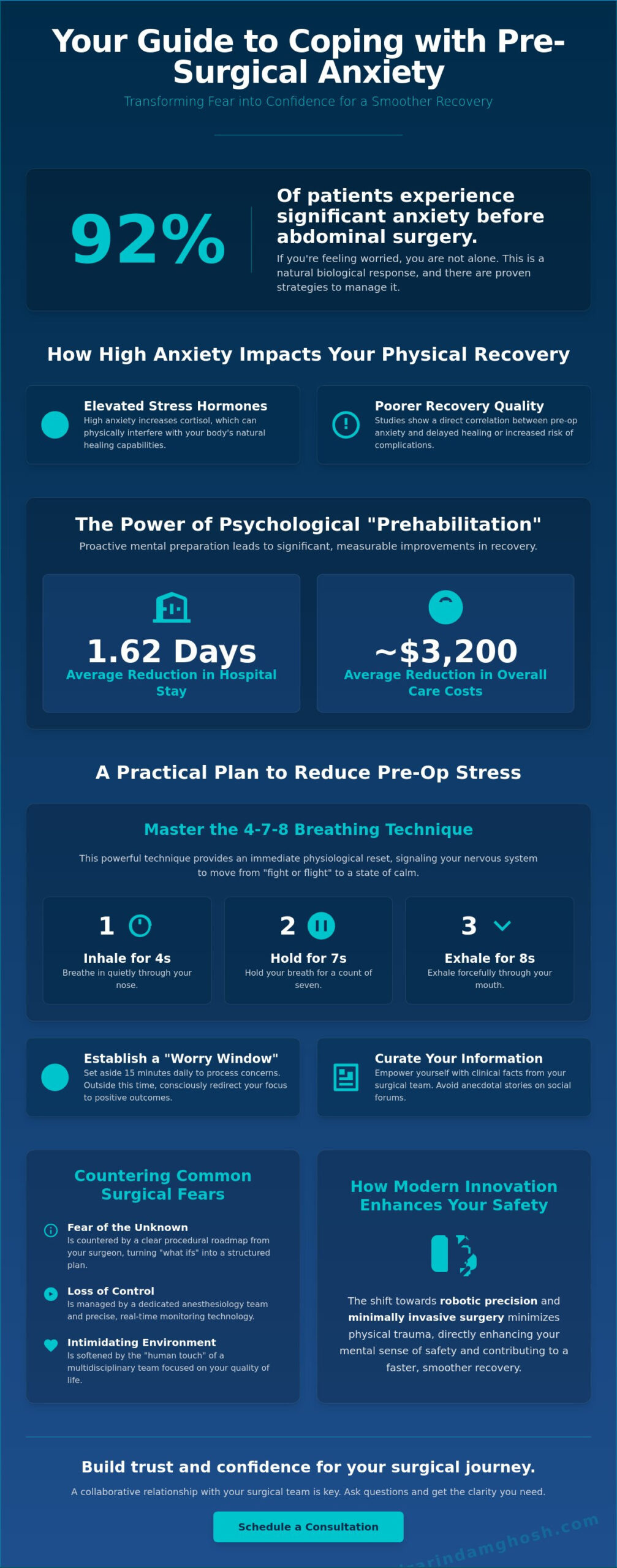
Did you know that a 2026 study found that 92% of patients experience significant anxiety before abdominal surgery? If you’re feeling a heavy sense of worry about anesthesia or the loss of control during a procedure, you’re certainly not alone. It’s understandable to feel overwhelmed by the complexity of modern surgical oncology. However, your mental readiness is just as vital as the robotic precision we use in the operating room.
In this article, you’ll discover professional strategies for coping with anxiety before major surgery that bridge the gap between clinical facts and the human experience. We’ll explore how psychological “prehabilitation” can reduce hospital stays by an average of 1.62 days and lower overall care costs by nearly $3,200. I’ll provide a clear, actionable plan for the days leading up to your admission, helping you replace cortisol-driven stress with a sense of calm, multidisciplinary support for a smoother path back to your quality of life.
Key Takeaways
- Understand why pre-operative anxiety is a natural biological response and how specific clinical knowledge transforms fear into informed confidence.
- Master practical tools like the 4-7-8 breathing technique and a pre-op checklist to actively lower stress hormones in the days leading up to your admission.
- Explore how the shift toward robotic precision and minimally invasive surgery minimizes physical trauma while enhancing your mental sense of safety.
- Discover professional strategies for coping with anxiety before major surgery by shifting your focus toward the “human touch” of a dedicated multidisciplinary team.
- Learn the specific questions to ask your surgeon that foster a collaborative relationship, ensuring your quality of life remains the primary goal of your care.
Table of Contents
- Understanding Pre-Surgical Anxiety and Its Impact on Your Recovery
- Practical Mental Strategies to Calm Your Mind Before the Procedure
- A Step-by-Step Practical Plan to Reduce Pre-Op Stress
- How Modern Surgical Innovation Minimizes Patient Fear
- Building Trust with Your Surgical Team for a Reassured Journey
Understanding Pre-Surgical Anxiety and Its Impact on Your Recovery
Feeling a sense of apprehension as you approach a scheduled surgery is a standard part of the human experience. As a surgeon, I see this daily in my practice. It isn’t just a mental state; it’s a biological response meant to protect you. However, when these feelings become overwhelming, we refer to it as Understanding Preoperational Anxiety. For some, this escalates into “tomophobia,” a clinical fear of surgical procedures. Recognizing the difference between normal jitters and a phobia is the first step in coping with anxiety before major surgery.
The impact of this stress isn’t limited to your thoughts. When your body is in a state of high alert, it releases elevated levels of cortisol. A 2026 study highlighted that high pre-operative anxiety is significantly correlated with poorer post-operative recovery quality. Elevated stress hormones can physically delay the healing process and increase the risk of complications like infections. I often tell my patients that their anxiety is actually a signal. It’s your mind’s way of asking for more information to feel safe. By addressing these concerns directly, we can lower those hormone levels and set the stage for a smoother recovery.
The Mind-Body Connection in the Operating Theater
Your mental state directly influences your physiological stability during the induction of anesthesia. A calm mind contributes to steady heart rates and blood pressure, which are critical for patient safety. We also focus on positive visualization during the surgical consultation process. Patients who mentally rehearse their successful recovery often experience earlier mobilization after procedures. This proactive approach turns a passive experience into a collaborative journey toward wellness. It’s about bridging the gap between cold clinical facts and the human experience of illness.
Common Triggers for Surgical Fear
Most fears stem from three specific areas. First is the fear of the unknown. Without a clear roadmap of the procedure, the mind often fills the gaps with worst-case scenarios. Second is the narrative of “loss of control” during anesthesia. We counter this by explaining the precise monitoring technology and the presence of a dedicated anesthesiology team. Finally, the clinical environment itself can feel intimidating. This is why I emphasize the “human touch” alongside robotic precision. When coping with anxiety before major surgery, knowing that a multidisciplinary team is watching over you helps shift the focus. We move from the clinical setting toward your eventual return to a high quality of life.
Practical Mental Strategies to Calm Your Mind Before the Procedure
Information acts as a clinical antidote to the “what if” scenarios that often dominate a patient’s thoughts. When you understand the methodical steps of your treatment, the unknown becomes a structured process. However, there is a delicate balance to maintain. I recommend my patients establish a “Worry Window,” which is a dedicated 15 minute period each day to process concerns or conduct research. Outside of this window, purposefully redirect your focus toward recovery. This boundary prevents the constant cycle of stress from overwhelming your daily routine while you are coping with anxiety before major surgery.
If you find your heart rate rising or thoughts racing, the 4-7-8 breathing technique offers an immediate physiological reset. Inhale through your nose for 4 seconds, hold your breath for 7 seconds, and exhale forcefully through your mouth for 8 seconds. This specific cadence helps lower your heart rate and signals your nervous system to move from a “fight or flight” state into a state of rest. For more structured guidance on managing these moments, resources like Coping with Anxiety Before Surgery provide excellent supplemental support for mental readiness.
Empowerment Through Education
Understanding the methodical steps of your procedure signals to the amygdala that the situation is managed and predictable, effectively dampening the brain’s fear response. It’s vital to curate your information carefully. I advise staying away from anecdotal “horror stories” on social forums; instead, stick to clinical data provided by your surgical team. Our multidisciplinary approach ensures that you aren’t just a patient on a table, but a participant in a high-tech healing process. If you have specific questions about your upcoming procedure, don’t hesitate to reach out to our clinical team for personalized clarification.
Cognitive Reframing Techniques
Words carry significant weight in how our brains perceive stress. Try replacing the phrase “I am scared of surgery” with “My body is preparing for a major positive change.” This simple shift acknowledges the intensity of the event while focusing on the beneficial outcome. Visualizing a successful recovery is another powerful tool. Imagine yourself six weeks post-op, engaging in your favorite activities with a renewed sense of health. This mental rehearsal anchors your mind to the ultimate goal: a restored quality of life. Surrounding yourself with a supportive social circle during this phase provides the emotional scaffolding needed to maintain this positive perspective until the day of your admission.
A Step-by-Step Practical Plan to Reduce Pre-Op Stress
Managing the logistical aspects of your care is a powerful method for coping with anxiety before major surgery. When you focus on “controlling the controllables,” you shift your brain’s energy from abstract worry to concrete action. This transition creates a sense of agency, transforming you from a passive recipient of care into an active partner in your surgical outcome. A structured plan for the week prior ensures that when the morning of your procedure arrives, your mind is free to focus on healing rather than administrative panic.
Physical optimization serves as the foundation for this mental readiness. Maintaining a protein-rich diet and staying hydrated in the days leading up to admission builds metabolic resilience. Data from 2026 shows that patients who engage in structured pre-surgical preparation can reduce their hospital stay by an average of 1.62 days. As noted by UMass Memorial Health on Coping with Anxiety, taking active steps to prepare your body directly impacts your emotional well-being. This holistic approach ensures that your physical state supports a calm, focused mind.
Optimizing Your Body for the Journey
Every healthy choice you make before surgery acts as a deposit into your recovery fund. Eliminating alcohol and nicotine for at least 14 days prior to your procedure significantly improves oxygen delivery to your tissues and reduces the workload on your heart. Gentle movement, such as a 20 minute daily walk, boosts circulation and releases endorphins that naturally combat stress. These actions aren’t just clinical requirements; they’re vital tools for coping with anxiety before major surgery, providing you with tangible evidence of your body’s strength and readiness.
The Final 48-Hour Countdown
The two days before surgery should be dedicated to peace and precision. Use this time to create a “recovery sanctuary” at home by preparing a comfortable space with clean linens, easy-to-reach essentials, and a clear path to the bathroom. This proactive step reduces the anxiety of returning home with limited mobility. During the final 48 hours, follow these steps to ensure a smooth transition:
- Verify Administrative Details: Confirm your insurance approvals and arrival times 48 hours in advance to prevent last-minute friction.
- Pack for Comfort: Include items that provide a “human touch,” like a favorite robe or a book, to make the clinical environment feel more personal.
- Strict Fasting Adherence: Follow NPO (nothing by mouth) instructions exactly, usually starting at midnight. This is a critical safety protocol that ensures your procedure proceeds as scheduled without delay.
By settling these details early, you protect your quality of life and enter the hospital with informed confidence. This methodical progression mirrors the deliberate care we take in the operating room, ensuring every detail is aligned for your success.
How Modern Surgical Innovation Minimizes Patient Fear
One of the most effective ways of coping with anxiety before major surgery is understanding how far surgical technology has advanced. In the past, the thought of “major surgery” often brought to mind images of large incisions and long, painful hospital stays. Today, the shift toward minimally invasive techniques has fundamentally changed that narrative. Procedures like a laparoscopic cholecystectomy now allow for gallbladder removal through tiny ports. This translates to significantly less physical trauma and a much lower “threat level” in the patient’s mind. When the physical impact is minimized, the psychological burden often follows suit.
Modern gastrointestinal surgery focuses on extreme precision, which directly correlates to reduced post-operative pain and a faster return to your daily routine. This clinical reality helps dismantle the fear of prolonged suffering or permanent loss of independence. By replacing the unknown with the predictable results of advanced technology, we create a pathway to informed confidence. The goal isn’t just a successful operation; it’s a return to your quality of life with as little disruption as possible.
The Precision of Robotic-Assisted Surgery
The introduction of robotic systems has added another layer of safety and reassurance for patients. For instance, robotic hernia repair provides surgeons with high-definition 3D visualization and a range of motion that exceeds the human hand. It’s vital to understand that these robotic tools are a sophisticated extension of the surgeon’s skill, not a replacement for it. This synergy of “robotic precision” and the “human touch” ensures that the most complex maneuvers are performed with incredible accuracy. Greater precision means fewer complications and less inflammation, which are key factors in coping with anxiety before major surgery. When the technology is this advanced, the margin for error is minimized, allowing you to trust the process more deeply.
Minimally Invasive Pathways to Healing
Knowing that your recovery will be measured in days rather than weeks provides immense psychological relief. This is especially true for metabolic procedures like a laparoscopic sleeve gastrectomy, where the focus is entirely on a rapid return to health. Smaller scars aren’t just about aesthetics; they serve as a visual reminder of a successful, modern intervention. This visual evidence of progress aids mental recovery by confirming that the body hasn’t undergone unnecessary trauma. If you’re feeling apprehensive about a specific procedure, I encourage you to schedule a consultation to see how our advanced technology can make your journey safer and more comfortable.
Building Trust with Your Surgical Team for a Reassured Journey
Establishing a clinical partnership with your surgeon is a cornerstone of coping with anxiety before major surgery. You aren’t just a case number; you’re the central focus of a dedicated team of professionals. This partnership model shifts the dynamic from a clinical transaction to a collaborative journey. When you view your surgeon as your primary advocate, the surgical suite transforms from an intimidating space into a controlled environment designed for your healing. Open, transparent dialogue about risks and expected outcomes is the most effective way to replace uncertainty with informed empowerment.
Trust is built through specific, methodical inquiry. During your pre-operative visit, don’t hesitate to ask questions that solidify your confidence in the team’s expertise. I encourage my patients to ask about the specific volume of procedures we perform and how our multidisciplinary approach manages potential complications. Knowing that an entire team of nursing and anesthesia staff is working in unison ensures that every aspect of your safety is monitored with robotic precision and a human touch. This comprehensive care model is designed to protect your quality of life at every stage of the procedure.
Effective Communication with Your Specialist
Expressing your specific anxieties is a vital part of the consultation process. You aren’t being “difficult” by asking for clarification; you’re being a proactive participant in your own wellness. If you feel a lingering sense of doubt, seeking a second opinion is a standard and respected practice that can help solidify your decision. We also establish a clear post-operative communication plan before you even enter the hospital. Knowing exactly how to reach your clinical team during recovery provides a mental safety net that significantly lowers stress levels after you return home.
The Multidisciplinary Approach to Safety
Complex procedures, such as gastrointestinal cancer surgery, require a team of experts working in perfect synchronization. This collective expertise includes oncologists, radiologists, and specialized nurses who follow rigorous safety protocols governed by national standards. These protocols are data-driven and focused on risk reduction, ensuring the highest level of clinical rigor. Ultimately, coping with anxiety before major surgery becomes easier when you realize that surgery is not an isolated event. It is a controlled, collaborative pathway to health, where every tool and every team member is dedicated to restoring your quality of life.
Embracing Your Pathway to Restoration and Health
Preparing for a procedure is a journey that requires both clinical precision and personal resilience. By understanding the methodical steps of your care and utilizing practical tools like the 4-7-8 breathing technique, you transform uncertainty into informed confidence. We’ve explored how modern innovations and a dedicated multidisciplinary team work in unison to protect your safety and speed your recovery. It’s about bridging the gap between high-tech intervention and the human experience of healing.
Successfully coping with anxiety before major surgery is possible when you view your treatment as a collaborative partnership focused on your quality of life. With over 25 years of surgical expertise, I specialize in bringing robotic and laparoscopic precision to premier hospitals across the UAE. My patient-centric approach ensures that your individual needs are always the priority, providing a sense of safety that clinical facts alone cannot offer.
Schedule a consultation with Dr. Arindam Ghosh to discuss your surgical journey with confidence and take the first step toward your restored health. You don’t have to face this transition alone; we’re here to ensure your path to wellness is as smooth and reassured as possible.
Frequently Asked Questions
Is it normal to feel like I want to cancel my surgery due to anxiety?
It is entirely normal and a documented experience for approximately 80% of surgical patients to feel a strong urge to withdraw. This reaction is a natural biological “fight or flight” response to a perceived threat. Instead of acting on the impulse, discuss these feelings with your surgeon to clarify the risks of delaying treatment versus the benefits of moving forward with your procedure.
Can pre-surgery anxiety affect the outcome of the operation?
High levels of stress can indeed influence your physiological recovery. Research indicates that elevated pre-operative distress is associated with a higher requirement for anesthetic agents and an increased risk of postoperative complications like infections or delirium. Managing your mental state is a clinical priority because a calm body typically experiences less inflammation and a faster return to daily activities.
What can I take for anxiety the night before my surgery?
You must not take any medication, including over-the-counter herbal supplements or sedatives, without explicit approval from your surgical team. Current ERAS (Enhanced Recovery After Surgery) Society guidelines generally advise against the routine use of preoperative benzodiazepines as they can interfere with early mobilization. If your anxiety is severe, we may prescribe a specific, safe intervention that doesn’t conflict with your anesthesia.
How do I explain my fear of anesthesia to the medical team?
The best approach is to be specific about what part of the process triggers your concern. Whether you fear postoperative nausea or the sensation of losing control, sharing these details allows the anesthesiologist to tailor your care. When coping with anxiety before major surgery, remember that the anesthesia team uses real-time monitoring technology to ensure your safety throughout every second of the procedure.
What are the best relaxation techniques for the morning of the procedure?
Guided imagery and progressive muscle relaxation are highly effective on the morning of your procedure. Focus on a specific, peaceful environment or mentally trace the path of your successful recovery. These non-pharmacological interventions help maintain stable vital signs during the transition to the operating theater, ensuring your body remains in a state of prepared rest rather than high alert.
Will the surgeon talk to me right before the operation starts?
Yes, I always meet with my patients in the pre-operative holding area before we proceed to the surgical suite. This brief consultation is a vital moment to answer any last-minute questions and reaffirm our treatment plan. This final “human touch” ensures we are aligned as a team and provides a final layer of reassurance before the clinical process begins.
How can my family help me manage my stress during the wait?
Your family can best support you by acting as a buffer for logistical stressors and providing gentle distraction. Having a loved one manage phone calls or insurance paperwork allows you to focus solely on your mental readiness. Their presence serves as a reminder of your life outside the hospital, which is essential for maintaining a positive perspective on your eventual quality of life.
What happens if I have a panic attack at the hospital?
If you experience a panic attack, our medical staff is fully trained to provide immediate, compassionate support. We can utilize both verbal de-escalation techniques and, if necessary, fast-acting clinical interventions to help you regain your composure. When coping with anxiety before major surgery, you are in the safest possible place to experience such an event, and our multidisciplinary team will prioritize your emotional stability.