

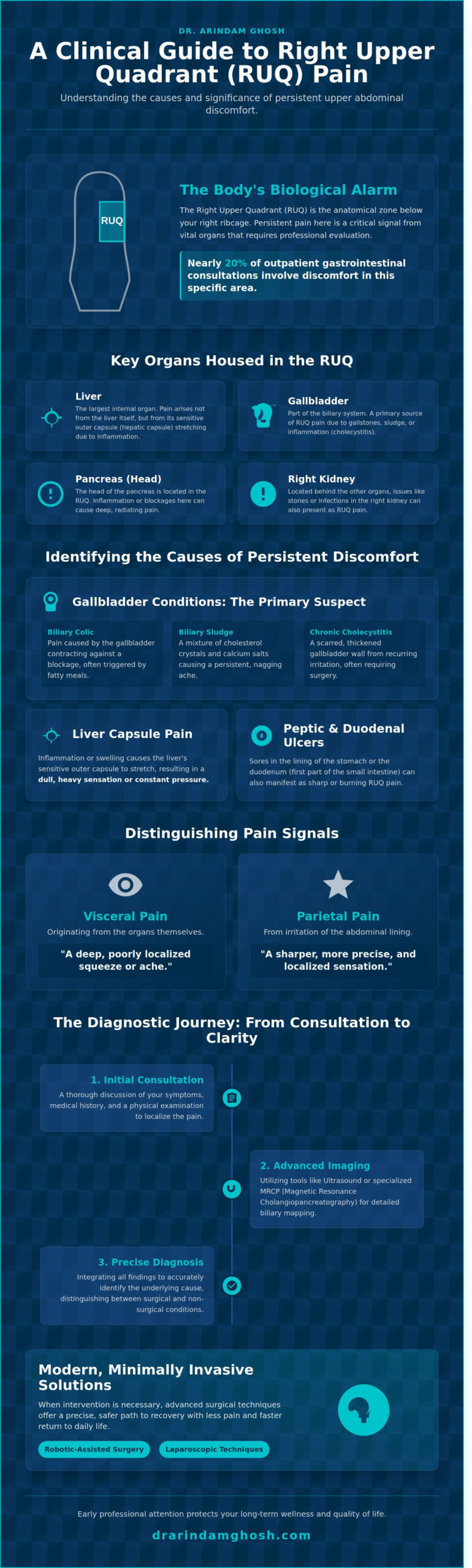
Last Tuesday, a patient visited our clinic after three weeks of trying to ignore a dull, gnawing sensation under their ribs, fearing that a diagnosis might mean immediate, invasive surgery. Living with persistent upper abdominal pain right side often feels like a stressful balancing act between hoping it’s just indigestion and worrying about silent gallbladder or liver disease. It’s a heavy emotional burden to carry when you’re trying to focus on your career or family life here in the UAE. Statistics suggest that nearly 20% of outpatient gastrointestinal consultations involve discomfort in this specific area, yet the path to relief often feels clouded by technical jargon and fear.
We recognize that the uncertainty of undiagnosed pain is often more draining than the physical discomfort itself. This article provides the clinical clarity you need by explaining the complex anatomy of the Right Upper Quadrant and the specific red flag symptoms that require professional attention. You’ll discover the diagnostic journey we take together, from advanced imaging to the precision of modern surgical solutions, all focused on restoring your digestive health and quality of life. We’ll explore the primary causes and the personalized care pathways that transform medical anxiety into a clear, hopeful plan for your recovery.
Key Takeaways
- Understand why pain in the Right Upper Quadrant is a significant clinical signal and how early professional attention protects your long-term wellness.
- Distinguish between various gallbladder conditions and learn the clinical framework used to determine if surgical intervention is necessary for your recovery.
- Navigate the diagnostic journey for persistent upper abdominal pain right side, from initial physical examinations to advanced biliary mapping with MRCP.
- Discover how modern robotic-assisted and laparoscopic techniques provide a precise, minimally invasive path toward restoring your digestive health and quality of life.
Understanding Right Upper Quadrant (RUQ) Pain: Anatomy and Significance
The Right Upper Quadrant (RUQ) is a critical anatomical zone located below the right ribcage, extending to the midline of the abdomen. This region houses several vital organs that are essential for digestion, detoxification, and metabolic balance. When patients experience persistent upper abdominal pain right side, it serves as a sophisticated biological alarm. My approach to surgical oncology and gastrointestinal health always begins with listening to this signal, as persistent pain often indicates an underlying issue that requires a multidisciplinary evaluation to protect your long term quality of life.
The primary organs in this quadrant include the liver, the gallbladder, the head of the pancreas, and the right kidney. While acute pain might appear suddenly due to a localized injury or a sudden blockage, persistent discomfort is defined by its recurring or chronic nature, often lasting for 12 weeks or more. This distinction is vital for accurate diagnosis. In the UAE, where lifestyle factors and dietary habits influence metabolic health, identifying the specific organ involved is the first step toward a personalized treatment plan that restores wellness and function.
The Biliary System: The Most Common Source of RUQ Pain
The biliary system is the primary network for fat digestion and waste transport. It consists of the gallbladder and a series of ducts that carry bile from the liver to the small intestine. This system is particularly prone to issues because bile can crystallize into stones, leading to blockages or significant inflammation. Understanding Cholecystitis, or inflammation of the gallbladder, is essential because it remains one of the leading causes of surgical consultations in the Middle East. When bile flow is obstructed, the resulting pressure causes a deep, often radiating ache that signals the need for expert intervention to prevent further complications.
The Role of the Liver and Surrounding Tissues
The liver is the largest internal organ, yet it lacks its own pain receptors. However, the thin layer of tissue surrounding it, known as the hepatic capsule, is highly sensitive. When the liver swells due to inflammation or other conditions, it stretches this capsule, resulting in a dull, heavy sensation that patients often describe as a constant pressure. This is a classic example of why persistent upper abdominal pain right side shouldn’t be ignored.
It’s also important to distinguish between different types of pain to guide treatment. Visceral pain is often felt as a deep, poorly localized squeeze originating from the organs themselves. In contrast, parietal pain occurs when the lining of the abdominal cavity is irritated, leading to a sharper and more precise sensation. Occasionally, issues with the diaphragm or the lower ribcage can mimic internal organ pain. A precise, robotic-assisted diagnostic approach can be highly beneficial in these cases, providing the clarity needed to move from uncertainty toward a state of informed empowerment.
Identifying the Causes of Persistent Right-Sided Abdominal Discomfort
Understanding the source of persistent upper abdominal pain right side requires a methodical clinical approach. The Right Upper Quadrant (RUQ) is a complex anatomical space housing the liver, gallbladder, and part of the small intestine. When discomfort lingers, it’s rarely a random occurrence; it’s a signal from your body that deserves a precise diagnosis to protect your long-term quality of life. A multidisciplinary perspective helps us look beyond the surface to identify whether the trigger is inflammatory, mechanical, or infectious.
Gallstones and Chronic Cholecystitis
The gallbladder is often the primary suspect in RUQ distress. Biliary colic happens when the gallbladder contracts against a blockage, typically after you’ve enjoyed a meal high in fats. While some patients have “silent” stones, others deal with biliary sludge. This mixture of cholesterol crystals and calcium salts can cause a nagging, persistent ache even without large stones. If left unmanaged, recurring irritation leads to chronic cholecystitis. In this state, the gallbladder wall becomes scarred and thickened, often necessitating a surgical solution to prevent more severe infections.
Peptic Ulcers and Duodenal Issues
The duodenum, which is the first segment of your small intestine, sits deep within the RUQ. It’s a frequent site for peptic ulcers, especially when H. pylori bacteria are present. You might notice a burning sensation that feels like “hunger pains,” which often improves temporarily after eating but returns with a vengeance a few hours later. Clinical data on common causes of RUQ pain indicates that inflammatory GI conditions can mimic gallbladder issues, making a thorough endoscopic evaluation vital for an accurate treatment plan.
Pancreatic and Renal Cross-over
Pain in the upper right side doesn’t always originate where you feel it. The “head” of the pancreas is positioned near the right side of the abdomen; inflammation here can cause deep, boring pain that radiates through to the back. Similarly, the kidneys can refer pain to the front. Kidney stones or infections often create a distinct “wrap-around” pattern, starting in the flank and moving toward the upper abdomen. Distinguishing these patterns is a core part of providing personalized gastrointestinal care that addresses the root cause rather than just the symptoms.
Liver-Related Concerns
We can’t overlook the liver when discussing right-sided sensations. While the liver itself doesn’t have many pain receptors, the capsule surrounding it is highly sensitive. Conditions like fatty liver disease or hepatitis can cause the organ to swell, stretching this capsule and creating a heavy, dull pressure. Early detection is paramount here. Modern diagnostic tools allow us to catch these changes before they progress to permanent scarring, ensuring we can implement a holistic plan for recovery and wellness.
Surgical vs. Non-Surgical Pain: When is Intervention Necessary?
Determining whether a patient requires a surgical solution for persistent upper abdominal pain right side involves a structured clinical framework. I focus on whether the underlying pathology is functional, meaning the organ isn’t working correctly, or structural, meaning there’s a physical blockage or tissue damage. Modern surgical practices have shifted their philosophy. We now focus on restoring a patient’s physiological harmony rather than simply removing tissue. This approach uses robotic and laparoscopic precision to ensure that the intervention leads to a better quality of life rather than just the absence of a diseased organ.
Evaluating your quality of life is a vital part of this process. When pain begins to dictate what you can eat or forces you to cancel professional commitments, it’s a sign that the condition is no longer manageable through observation alone. Ignoring chronic RUQ pain is risky. Leaving a diseased gallbladder or a localized lesion untreated can lead to biliary obstruction or severe systemic infections. By analyzing the causes of right-sided abdominal pain, we can determine if the risk of the condition outweighs the minimal risks associated with modern, minimally invasive surgery.
Signs That Your Pain May Require Surgical Evaluation
- Recurrent biliary colic: This manifests as intense, episodic pain that interferes with your daily nutrition and prevents restful sleep.
- Diagnostic imaging findings: Evidence of gallbladder wall thickening exceeding 3mm or signs of chronic inflammation often necessitates a surgical consultation.
- Failure of conservative care: Surgical necessity is the point where medical management fails to prevent recurrent symptomatic episodes.
Conditions Managed Through Medical Therapy
Not every instance of persistent upper abdominal pain right side leads to the operating room. We manage many cases of gastritis and GERD through personalized lifestyle changes and pharmacological intervention. Dietary habits play a significant role in digestive health. We often find that dietary modification can successfully manage functional gallbladder disorders where motility is the primary issue.
A multidisciplinary approach is the gold standard for patient safety. This involves a collaborative team where we combine targeted medication with close surgical monitoring. This ensures that if a condition progresses, we transition from medical therapy to a surgical solution at the optimal time. It’s a pathway designed to lead you from uncertainty toward a state of informed empowerment and lasting wellness.
The Diagnostic Journey: From Consultation to Clarity
Every successful recovery begins with a conversation. Identifying the source of persistent upper abdominal pain right side requires a methodical approach that balances advanced technology with clinical intuition. We start by listening to your history; the timing of your pain and its relationship to meals provide vital clues. A physical examination follows, where we check for localized tenderness or organ enlargement in the right upper quadrant. This initial step is fundamental in filtering out common issues before moving to specialized testing.
Blood markers act as our internal compass during this journey. We typically request a comprehensive panel including:
- Liver Function Tests (LFTs): These measure enzymes and proteins that indicate if the liver or bile ducts are under stress.
- Inflammatory Markers: Tests like C-Reactive Protein (CRP) help us identify active infections or systemic inflammation.
- Amylase and Lipase: These are crucial for ruling out pancreatic involvement, which can often mimic gallbladder distress.
The Role of Diagnostic Gastroscopy and Colonoscopy
Direct visualization is often necessary to rule out conditions like peptic ulcers, severe gastritis, or inflammatory bowel disease. Diagnostic gastroscopy allows us to examine the esophagus and stomach lining with high-definition clarity. We prioritize the “human touch” during these procedures, ensuring you feel safe and comfortable through gentle sedation and clear communication. These findings are pivotal; they help us determine if your pain is a medical issue that requires specialized medication or a surgical concern that needs a more direct intervention. By identifying polyps or inflammation early, we can tailor a plan that protects your long-term health.
Advanced Biliary Mapping
Ultrasound remains the gold standard for initial gallbladder screening in the UAE because it’s non-invasive and offers a 95% sensitivity rate for detecting gallstones. However, when we need to see deeper into the biliary tree, we turn to Magnetic Resonance Cholangiopancreatography (MRCP). This specialized scan provides robotic precision in mapping the bile ducts, allowing us to see exactly where a blockage might exist. We distinguish between structural blockages, like stones, and functional issues where the digestive flow is simply sluggish. This level of detail ensures our multidisciplinary team can recommend a path that restores your quality of life without unnecessary guesswork.
Advanced Solutions: Minimally Invasive and Robotic-Assisted Care
The field of gastrointestinal surgery has undergone a radical transformation over the last two decades. Traditional open surgeries, which once required large incisions and lengthy hospital stays, have largely been replaced by sophisticated, minimally invasive techniques. For patients dealing with persistent upper abdominal pain right side, these advancements mean that relief no longer requires a grueling recovery process. Modern surgical interventions focus on high-tech precision to ensure the best possible clinical outcomes while prioritizing your comfort.
Laparoscopic cholecystectomy remains the definitive gold standard for treating gallbladder-related pain. This procedure involves small, keyhole incisions rather than a single large opening. By using a specialized camera and miniature instruments, surgeons can remove the gallbladder with minimal trauma to the surrounding tissues. Dr. Arindam Ghosh brings 25 years of surgical expertise to these procedures, ensuring that even complex cases are handled with a level of care that only decades of experience can provide. This approach significantly reduces post-operative discomfort and allows many patients to return home within 24 hours.
Laparoscopic and Robotic Excellence
Robotic-assisted surgery represents the next frontier in gastrointestinal care. By utilizing robotic systems, the surgeon gains a high-definition, 3D view of the internal anatomy, magnified up to 10 times. This enhanced visibility allows for meticulous dissection and suturing that surpasses the capabilities of the human hand alone. It’s not just about the technology; it’s about how that technology serves the patient. Robotic precision leads to less blood loss and a lower risk of infection, which are critical factors for those undergoing complex GI oncology or bariatric procedures.
The benefits of a minimally invasive approach extend far beyond the operating room. A quicker return to your quality of life is the primary goal. Patients often find they can resume light activities within a few days, compared to the weeks of downtime required by traditional methods. In the United Arab Emirates, where healthcare standards are among the highest globally, integrating this technology with a multidisciplinary team approach ensures that every aspect of your health is monitored by specialists in oncology, nutrition, and internal medicine.
Your Pathway to Recovery
If you’re struggling with persistent upper abdominal pain right side, the journey toward wellness begins with a thorough surgical consultation. During this meeting, Dr. Ghosh evaluates your diagnostic history, including ultrasound or CT results, to determine if a surgical solution is the most effective path forward. We don’t just treat symptoms; we look for the root cause to create a personalized, holistic treatment plan tailored to your specific physiological needs.
The transition from a diagnosis to recovery is a collaborative process. We provide clear guidance on pre-operative preparation and what to expect during the healing phase. Our commitment to your health doesn’t end when the procedure is over. We offer continuous support to ensure your transition back to a pain-free life is seamless and successful. Your health is an investment, and choosing a path backed by innovation and compassion is the first step toward lasting relief.
Schedule a comprehensive evaluation for your persistent abdominal pain with Dr. Arindam Ghosh to explore your options for advanced, minimally invasive care.
Prioritizing Your Path to Lasting Relief
Living with persistent upper abdominal pain right side shouldn’t be your daily reality. Whether discomfort stems from gallbladder issues or complex gastrointestinal conditions, obtaining an accurate diagnosis is the essential first step toward recovery. Modern medical advancements in the UAE now allow for precise interventions that prioritize your comfort and long-term health. Knowing when a condition requires surgical expertise rather than simple observation can significantly improve your recovery timeline.
Dr. Arindam Ghosh brings over 25 years of surgical excellence in GI and bariatric care to every patient he treats. By combining robotic precision with a compassionate human touch, he ensures that complex procedures are performed with minimal downtime. His multidisciplinary approach to digestive health focuses on restoring your quality of life through advanced robotic-assisted and laparoscopic techniques. You don’t have to navigate these health challenges alone when world-class care is within reach.
Take the first step toward reclaiming your wellness today. Book a Specialist Consultation with Dr. Arindam Ghosh to begin your journey toward a pain-free life. It’s time to move forward with confidence and clarity.
Frequently Asked Questions
Is persistent right upper abdominal pain always serious?
Persistent right upper abdominal pain isn’t always a medical emergency, but it serves as a critical signal from your body that requires professional evaluation. While it can stem from benign issues like indigestion, it often indicates underlying conditions such as gallstones, which affect 10% to 15% of the adult population. Seeking a clinical diagnosis early ensures we can address the root cause before it impacts your daily quality of life.
Can gas cause persistent pain on the right side under the ribs?
Gas can cause sharp or cramping discomfort on the right side under the ribs, a condition often referred to as hepatic flexure syndrome. This occurs when air becomes trapped in the curves of the colon. However, gas pain is usually transient and typically resolves within 24 hours. If your persistent upper abdominal pain right side lasts longer than two days or recurs frequently, it’s likely not gas and needs a multidisciplinary diagnostic approach.
How do I know if my right-sided pain is coming from my gallbladder or my liver?
Gallbladder pain usually presents as sharp, episodic biliary colic that intensifies after fatty meals, often radiating to the right shoulder. Liver pain tends to be a dull, steady ache caused by the stretching of the liver’s capsule, often associated with swelling or inflammation. Clinical studies show that 80% of gallbladder issues involve stones. We use precise imaging like ultrasound to differentiate between these organs and create a personalized treatment plan.
When should I see a specialist for upper abdominal pain?
You should consult a specialist if your pain persists for more than three consecutive days or if it frequently interrupts your sleep and work. Chronic discomfort often points to surgical conditions that require advanced intervention, such as laparoscopic or robotic-assisted surgery. Early consultation with a gastrointestinal expert in the UAE can prevent complications like bile duct blockages. Our goal is to move you from uncertainty toward a state of informed empowerment.
What are the red flag symptoms that mean I should go to the emergency room?
You must seek immediate emergency care if your abdominal pain is accompanied by a fever over 38.3°C, yellowing of the eyes, or persistent vomiting. These red flags often indicate acute cholecystitis or a bile duct obstruction, which require urgent medical attention. According to clinical protocols, sudden and worsening pain that prevents you from sitting still is a clear sign of a surgical emergency. Don’t delay, as rapid intervention is vital for protecting your long-term health.
Can stress cause persistent pain in the upper right quadrant?
Stress can exacerbate persistent upper abdominal pain right side by increasing muscle tension and altering gut motility through the brain-gut axis. While psychological factors contribute to functional dyspepsia, we must first rule out organic causes like ulcers or gallbladder disease through objective testing. Approximately 20% of patients with chronic abdominal discomfort have symptoms worsened by high stress levels. We take a holistic view, ensuring that both physical triggers and lifestyle factors are addressed.
What is the most common diagnostic test for right-sided abdominal pain?
An abdominal ultrasound is the primary diagnostic tool used to evaluate right-sided pain because it’s non-invasive and highly accurate for detecting gallstones. This test has a sensitivity rate of over 95% for identifying biliary issues. If the ultrasound results are inconclusive, we may utilize more advanced technology like an MRI or a CT scan. These tools allow our multidisciplinary team to visualize your internal structures with robotic precision, ensuring an accurate diagnosis before any surgical pathway begins.
How long does it take to recover if surgery is required for gallbladder pain?
Most patients return to their normal activities within 7 to 14 days following a laparoscopic gallbladder removal. This minimally invasive approach uses small incisions, which significantly reduces recovery time compared to traditional open surgery. You’ll typically be discharged from the hospital within 24 hours of the procedure. We focus on high-tech compassion to ensure your transition back to a meaningful, healthy existence is as smooth and efficient as possible.